
Study timer: 25, 50 or 90 minutes — which works best?
 Beyond Alarm24 October 2026 · 8 min read
For most studying, start with a 50-minute study timer and a 10-minute break. Use 25 or 30 minutes when the work is dull or you are tired, and 90 minutes only for exam practice or work you can already sit through. No length is proven best; fixed breaks are what the evidence supports.
So the honest answer to "which works best" is: the longest one you can finish without picking up your phone. The rest of this page is how to find that number in a week.
The short version:
- Default: 50 minutes on, 10 off.
- Hard to start, tired, or flashcards: 25 or 30 minutes on, 5 off.
- 1 hour study timer: good for essays and problem sets, once 50 holds.
- 90 minutes: for timed past papers. The "90-minute rhythm" is weakly supported when you are awake.
- Stopwatch first, timer second. Measure how long you really focus, then set the timer a little above it.
- Whatever the length, the break has to have an end. A feed doesn't.
Every study timer length, compared
People search for a 25, 30, 50, 60 or 90-minute study timer as if one of them were correct. They each suit a different kind of work.
| Length | Break | Best for | Weak point | Evidence behind the number |
|---|---|---|---|---|
| 25 min | 5 min | Starting, flashcards, tired days | Too short for hard problems | Chosen by the Pomodoro method's creator, not tested against others |
| 30 min | 5 min | Reading, vocabulary, revision lists | Same as 25, slightly less fiddly | None for the number itself |
| 50 min | 10 min | Problem sets, essays, coding | Attention can sag around minute 35 at first | Popular rule of thumb; no direct study |
| 60 min | 10-15 min | Long essays, practice questions | Hard to hold if you are not used to it | None for the number itself |
| 90 min | 20 min | Timed past papers, deep work you already sustain | Most people drift well before the end | A sleep-cycle idea, unconfirmed for waking hours |
| Stopwatch | When you stop | Finding your real focus span | No finish line to push towards | Not a method, a measurement |
The pattern in the last column is the point. None of these numbers has been shown to beat the others for studying. What has some support is the structure around them.
What the research actually supports
Fixed breaks beat deciding as you go. In a 2023 study by Biwer and colleagues, 87 Dutch university students studied their own material for a day. Some took a 6-minute break after every 24 minutes, some a 3-minute break after every 12, and some chose their own breaks.
The students who chose their own breaks studied and rested for longer stretches, and reported more fatigue and distraction and less concentration and motivation. Task completion was the same in all three groups. Note what did not matter: the 12-minute and 24-minute groups both did better than self-paced breaks, which suggests the length matters less than having one.
It is one study of 87 students over one day, so treat it as encouraging, not settled.
Breaks restore performance. A 2016 analysis of Danish school tests by Sievertsen, Gino and Piovesan found that pupils scored lower the later in the day they sat a test, and that a 20- to 30-minute break before the test improved scores. That is children taking standardised tests, not students revising, but it fits: attention runs down and a real break brings some of it back.
The 52/17 rule is weak evidence. It comes from DeskTime, a time-tracking company. In 2014 it looked at the top 10% of its users, ranked by time in apps it counts as productive, and found they worked about 52 minutes and broke for 17. When it repeated the analysis in 2021, the figure was 112 minutes on and 26 off.
That is company data about office workers, with no sample size published on the page, and it describes what productive people happened to do rather than testing whether the rhythm caused anything. The fact that the number more than doubled in seven years is the clearest sign that it is not a law.
The 90-minute rhythm is real in sleep, uncertain awake. The idea comes from Nathaniel Kleitman's "basic rest-activity cycle": the roughly 90-minute cycle of sleep stages, which he proposed carries on through the day. A 2008 book chapter on performance rhythms by LaJambe and Brown put it plainly: no confirmation has been reached that the night-time cycle continues as a 90-minute rhythm of daytime alertness.
So "study in 90-minute blocks because of your ultradian rhythm" is a nice story with thin support. Ninety minutes can still be a good length; it just is not good for that reason.
30 minute or 1 hour study timer: how to choose
If you are deciding between the two lengths most people type in, ask how long the work takes to get going.
- A 30 minute study timer suits work you can pick up cold: flashcards, reading notes, vocabulary, a set of short questions. Four rounds with 5 minutes between them is two hours of solid revision.
- A 1 hour study timer suits work with a warm-up: an essay, a proof, a long problem, code. If the first 10 minutes go on remembering where you were, a 30-minute round wastes a third of itself.
A useful rule: move up a length only when the shorter one holds. If you cannot finish 30 minutes without checking anything, an hour just gives you longer to fail in. Past papers are the exception - practise at the length of the real exam.
Timer or stopwatch for studying?
A countdown timer and a stopwatch for studying do different jobs, and most people only ever use the first.
A stopwatch answers a question: how long do you actually focus? For three or four sessions, start it when you begin and stop it the moment you drift - phone, kitchen, a tab you did not need. Write the number down.
A timer then gives you a finish line. Set it about five minutes above your typical stopwatch number and you have a length that stretches you without setting you up to fail. If your honest stretch is 22 minutes, a 25-minute timer is right, whatever the internet says about 50.
Beyond Alarm
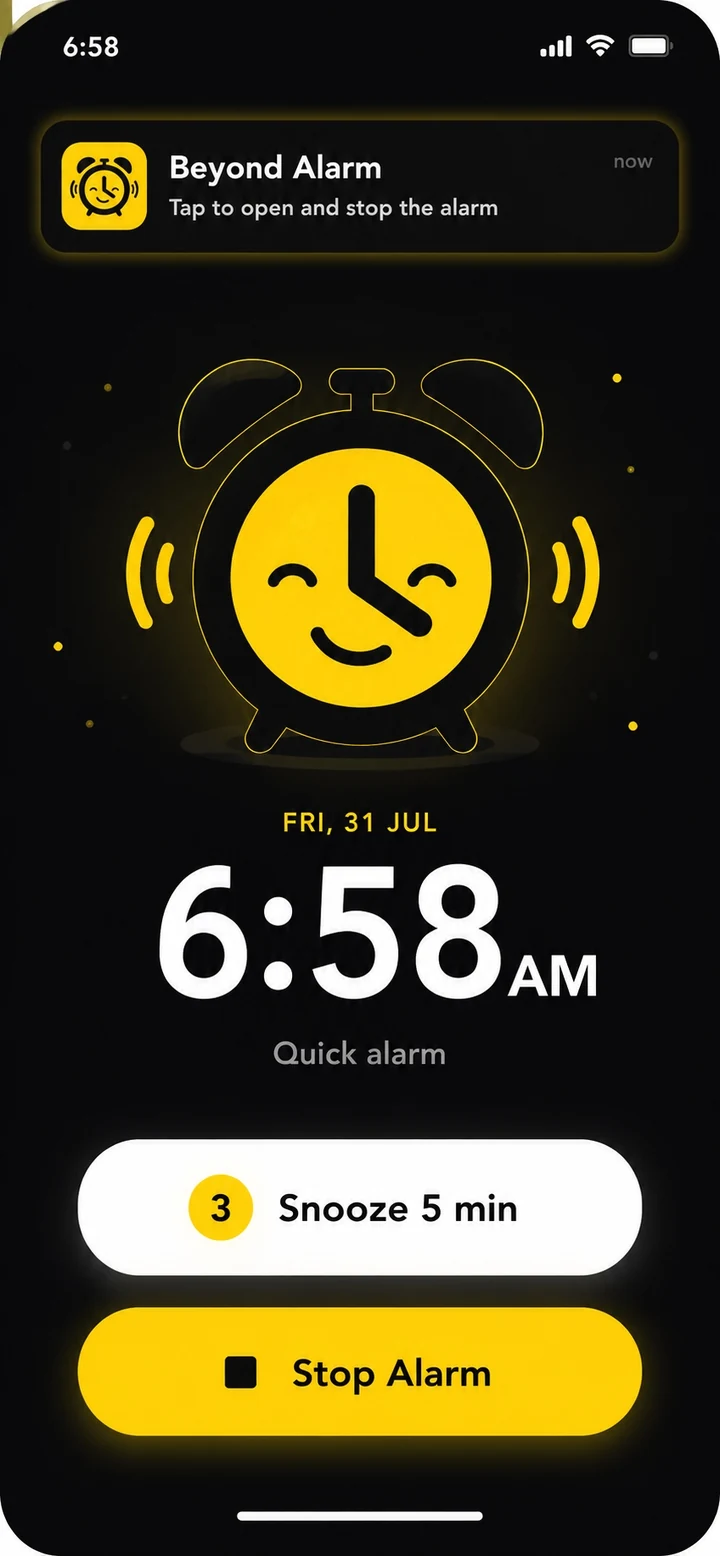
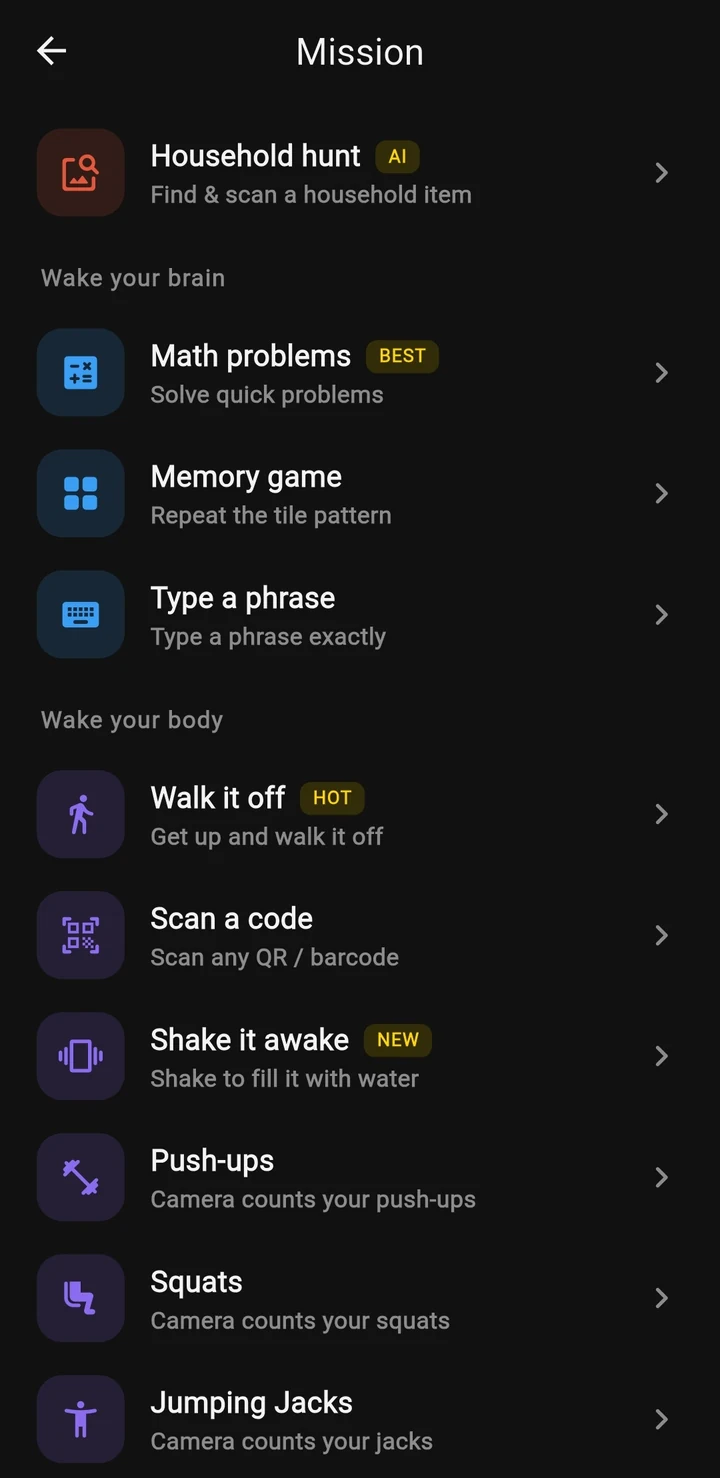
Beyond Alarm does this part for you: the alarm will not switch off until you have actually moved, and the apps you pick stay locked afterwards.


A one-week test to find your length
Run this alongside your normal studying. It costs nothing but a notebook.
- Days 1-2: stopwatch only. Log each stretch until you drift.
- Day 3: take your typical stretch, add five minutes, round to 25, 30, 45 or 50. That is your timer.
- Days 3-5: use that timer with a fixed break: 5 minutes after 25-30, 10 minutes after 45-60. Tally finished rounds, not hours at the desk.
- Day 6: if you finished nearly every round, try the next length up.
- Day 7: keep whichever gave you more finished rounds in total.
The measure that matters is finished rounds. A desk you sat at for four hours with the phone beside you is not four hours of study.
What actually breaks a study session
When a round fails, it is rarely the timer's length. It is the phone: the quick check at minute 12, or the 5-minute break that turns into 25 on a feed with no end.
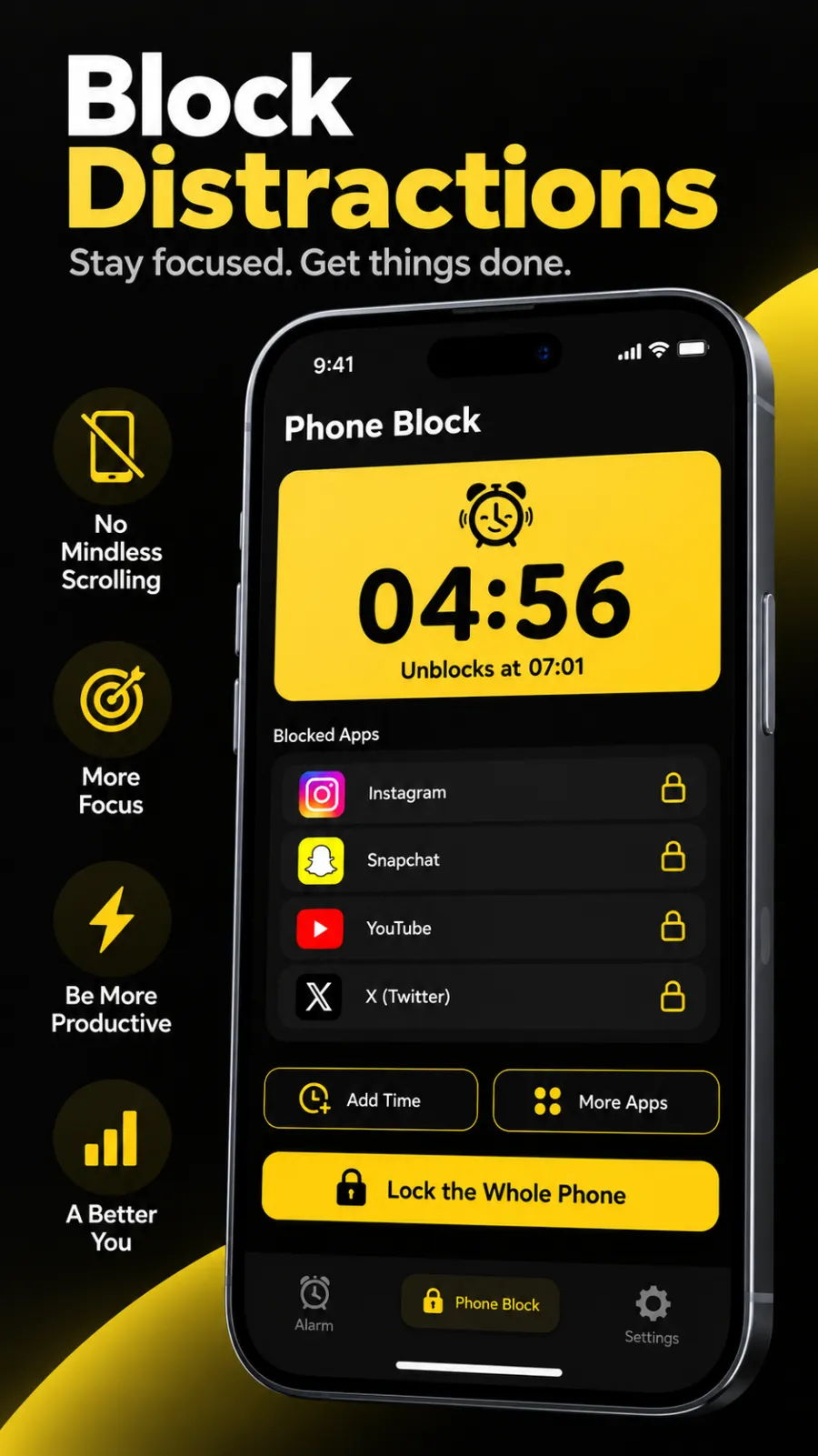
The fix that works is to take the pull out of the room for the whole session, breaks included. Phone in another room is the free version. If the phone has to stay - it is your timer, or your group chat - block the apps that pull for the length of the session. We covered which apps to put on the list in how to block apps while studying, and the options for a timed lock, including ones you cannot cancel, in how to lock your phone for an hour.
The gentle built-in tools - Focus modes, app timers, Screen Time limits - can be switched off in a tap, which is why they often stop working after the first week.
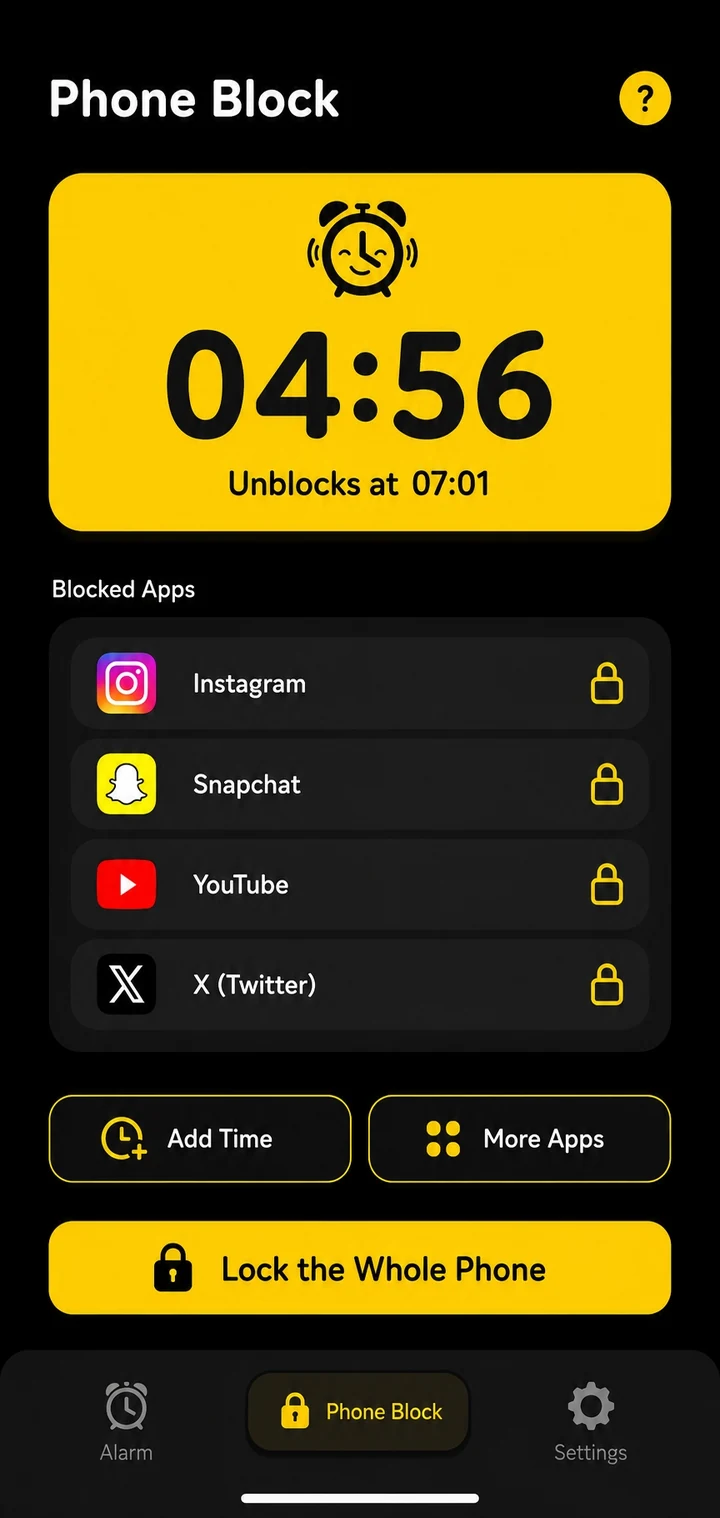
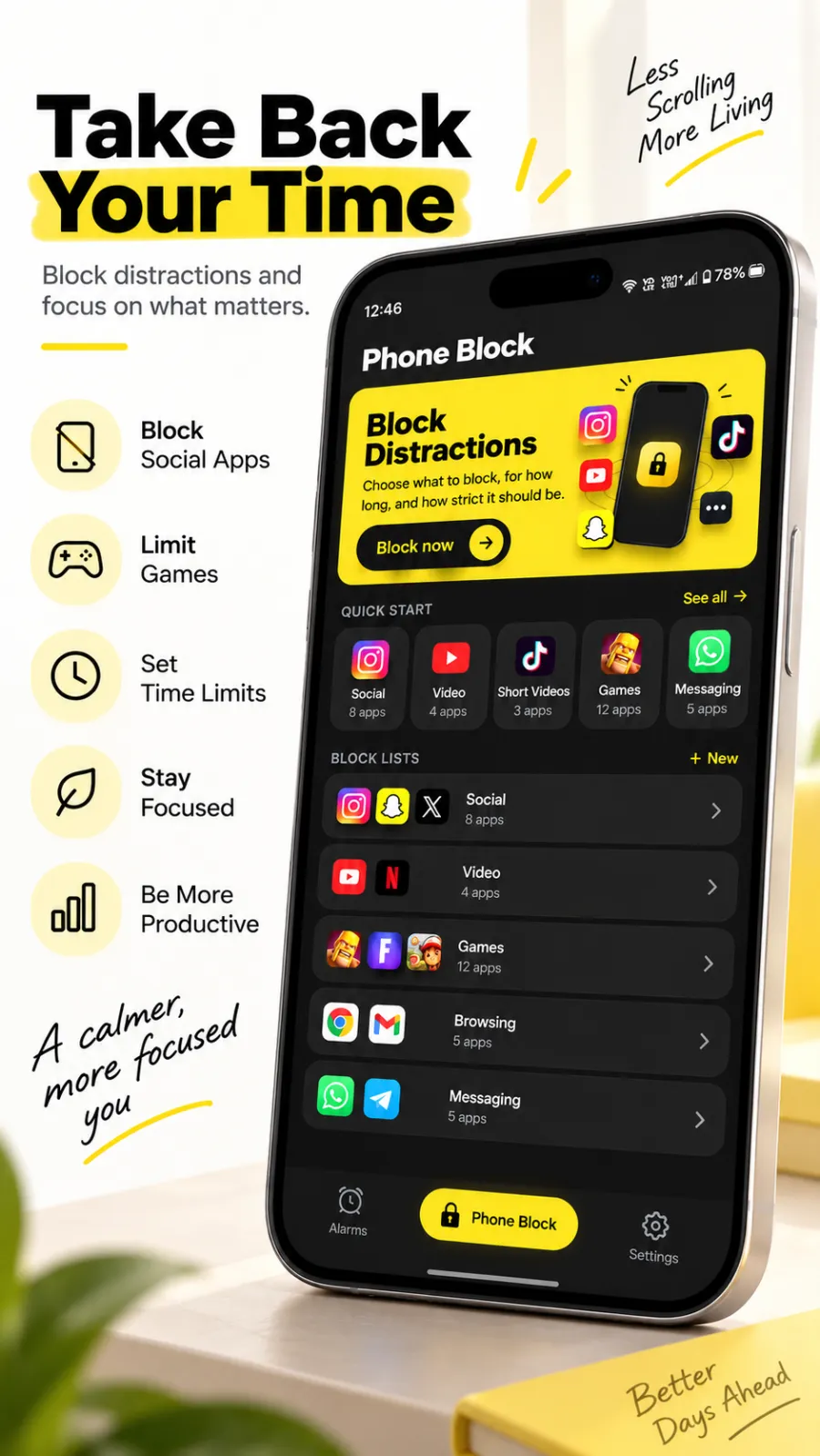
To be clear about what Beyond Alarm's Phone Block is: it is not a study timer. There is no work/break cycle and no round counter, so you still need a timer for the rhythm. What it does is block chosen apps for a set time, which in our app you start by hand: presets of 15, 30, 45, 60, 90 and 120 minutes, or Custom from 5 minutes to 8 hours, so a 50-minute block is a Custom entry. Strict lets you leave early after a short ad and a five-second hold; Hard mode has no stop button until the timer ends. On Android it can block chosen apps or the whole phone, with calls still coming through. On iPhone it uses Apple's Screen Time, blocks only the apps or categories you pick, and turning off its Screen Time access in Settings ends the block. Block the whole session, breaks included - if the block ends at every break, the break is where the feed comes back.
Free study timers that are good enough
You do not need a special app to time a study session.
- Your phone's clock app. Every phone has a countdown timer and a stopwatch. Put the phone face down across the room.
- A kitchen timer. The original tool, and it keeps the phone out of the loop entirely.
- A search engine timer. Searching "50 minute timer" on a laptop brings up a countdown in the results - no phone involved.
- Study-with-me videos on a laptop or TV, if you like company and someone else's timer.
- Focus timer apps such as Forest, which pair a timer with staying off your phone. Pricing differs between Android and iPhone at the time of writing, so check the listing.
Pick the length, not the gadget. A 30-minute round you finish beats a 90-minute one you abandon at minute 40.
Common questions
What is the best study timer length?
There is no proven best length. A good default is 50 minutes of study and a 10-minute break; drop to 25 or 30 minutes for dull material or tired days, and use 90 minutes only for exam practice or work you can already sit through. The research supports fixed breaks more than any one number.
Is studying for 1 hour without a break too long?
Not if you can hold it. An hour suits essays, problem sets and past papers, where getting back into the work is slow. If you keep reaching for your phone at minute 35, the hour is too long for you right now - drop to 45 or 50 minutes and build up.
Is a 30 minute study timer enough?
Yes, for flashcards, vocabulary, reading notes and anything you find hard to start. Several 30-minute rounds with 5-minute breaks add up fast. It is usually too short for long proofs or essays, where the first 10 minutes go on getting back into the problem.
Should I use a timer or a stopwatch for studying?
Use a stopwatch for a few days to find out how long you actually focus, stopping it the moment you drift. Then switch to a countdown timer set a little above that number. The stopwatch tells you the truth; the timer gives you a finish line.
Does the 52/17 rule work for studying?
It might suit you, but the evidence for it is weak. It comes from a time-tracking company looking at its most productive users in 2014, not from a study of students, and the same company later found a 112/26 pattern instead. Treat it as one option to test, not a rule.
We build Beyond Alarm, an Android alarm app that will not switch off until you have actually moved. Most of what we write here comes out of problems we hit building it.
Beyond Alarm
An alarm that keeps ringing until you’ve actually moved — then blocks the apps that pull you back to bed. Free to start, no account.
Keep reading
Digital detox: a 7-day plan that doesn't need a cabin
A 7-day digital detox you can do at home - one change a day, from notifications to an offline afternoon, then a plan for what comes back.
How much screen time is normal? What the numbers say
How much daily screen time is normal for adults, teens and young children, from Ofcom, GWI and WHO, and how to find your own number on iPhone or Android.