
Why your alarm stopped waking you up
 Beyond Alarm24 August 2026 · 7 min read
Photo by cottonbro studio on Pexels
Type the question into a search box and you will get the same answer everywhere: you habituated to the sound, so change your tone every few weeks.
We followed that advice back to its citations. They are a study of snooze-button presses, and a study of 21 awake men in a digger simulator. Neither one involved a sleeping person.
That does not make the advice wrong. It makes it a guess that has been repeated until it sounds like a finding — and the guess is pointing you at the wrong part of the problem.
The advice, and where its evidence actually goes
Two representative versions of it. Mudita's guide to alarm sounds says "sleep experts recommend refreshing your alarm tone every three to four weeks to keep your brain from slipping into autopilot," and — to its credit — actually cites sources for the habituation claim. Bellman's makes the same argument and cites nothing at all.
So we read Mudita's two citations. Here is what they measured.
| The citation offered | What it actually studied | Were the subjects asleep? |
|---|---|---|
| Snooze alarm use in a global population of smartphone users (Robbins et al., Scientific Reports, 2025) | 3 million nights of snooze-button behaviour: 55.6% of sessions ended in a snooze, 2.4 presses, 10.8 minutes | Yes — but it never varied or tested a tone |
| Effectiveness of alarm sounds in preventing operator habituation (Chae et al., Automation in Construction, 2024) | 21 people in a driving simulator, reaction time and skin conductance | No — awake, operating heavy equipment |
The first is a genuinely interesting dataset and we have written about what it says about stacking alarms. It does not contain a finding about tone habituation, because it never changed anyone's tone.
The second is about habituation, properly measured — in construction equipment operators who are awake and being warned about blind spots. Whether an awake operator's response to a repeated proximity beep transfers to a sleeping person's response to a 6am alarm is exactly the question, and that paper does not answer it.
What the review literature says
This is the part that surprised us.
There is a systematic review of precisely this area: Alarm Tones, Voice Warnings, and Musical Treatments (McFarlane et al., Clocks & Sleep, 2020), covering 12 studies published between 1992 and 2020.
It does not examine habituation to repeated alarms anywhere. The studies it reviews look at acute effects — what a given sound does to you this morning — not adaptation over weeks. And on the broader question it is blunt: for adults woken abruptly, there is "insufficient evidence to support firm conclusions regarding alarm types and voice signals."
So the honest state of things is not "habituation to your alarm is a myth." It is that nobody has run the study. Thirty years of research into waking people up with sounds, and the single most repeated piece of advice about alarm tones sits in a gap in it.
What that same group did find, in a 2020 survey of 50 people, is that melodic sounds were associated with less reported grogginess than neutral ones (p = 0.023). Worth knowing — and worth saying that it is 50 people, self-reported, with no sleep staging and no reaction-time test behind it. It is a hint, not a lever.
The thing that is measured: the state, not the sound
While the tone question sits empty, the question of what state you wake into has just been answered at scale.
In January 2026, PLOS One published a nationwide study of morning sleep inertia covering 2,355 people aged 19 to 92 in South Korea. Mean duration of morning grogginess: 15.8 minutes. And the things that lengthened it:
| Associated with longer morning grogginess | Strength |
|---|---|
| Anxiety | +14.3 minutes (Cohen's d = 1.12) |
| Insomnia | β = 0.22 |
| Evening chronotype | β = 0.12 |
| Morning chronotype | β = −0.16 (shorter) |
| Longer sleep | β = −0.05 (shorter) |
Anxiety nearly doubling the window is the number to sit with. The authors are careful about their limits and so are we: sleep inertia was captured with a single subjective question, the design is cross-sectional so none of this proves causation, and there was no polysomnography.
Still — look at what that list is made of. Every entry is a state. They change from week to week and season to season. Your ringtone does not. If your alarm worked in June and stops working in August, the list above contains far more plausible culprits than the audio file.
Beyond Alarm
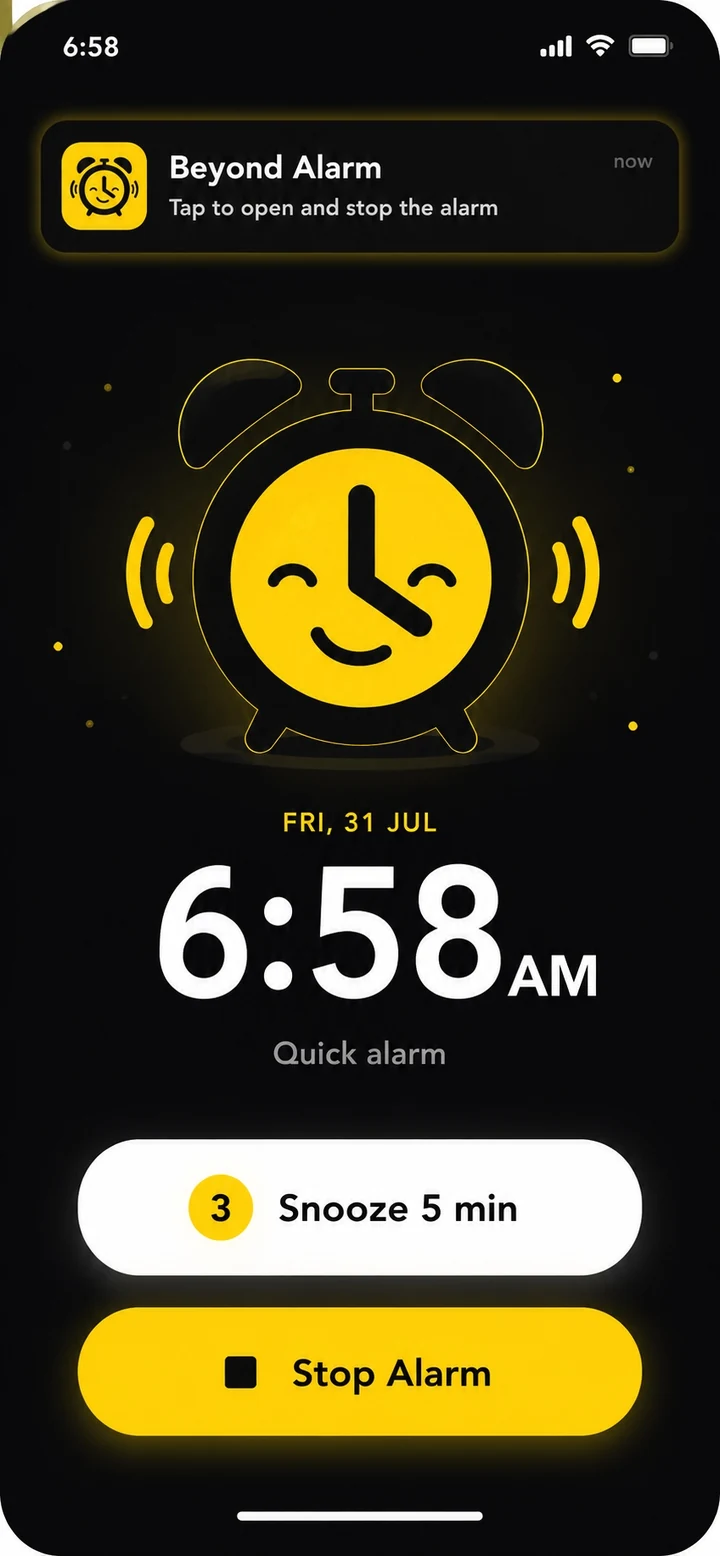
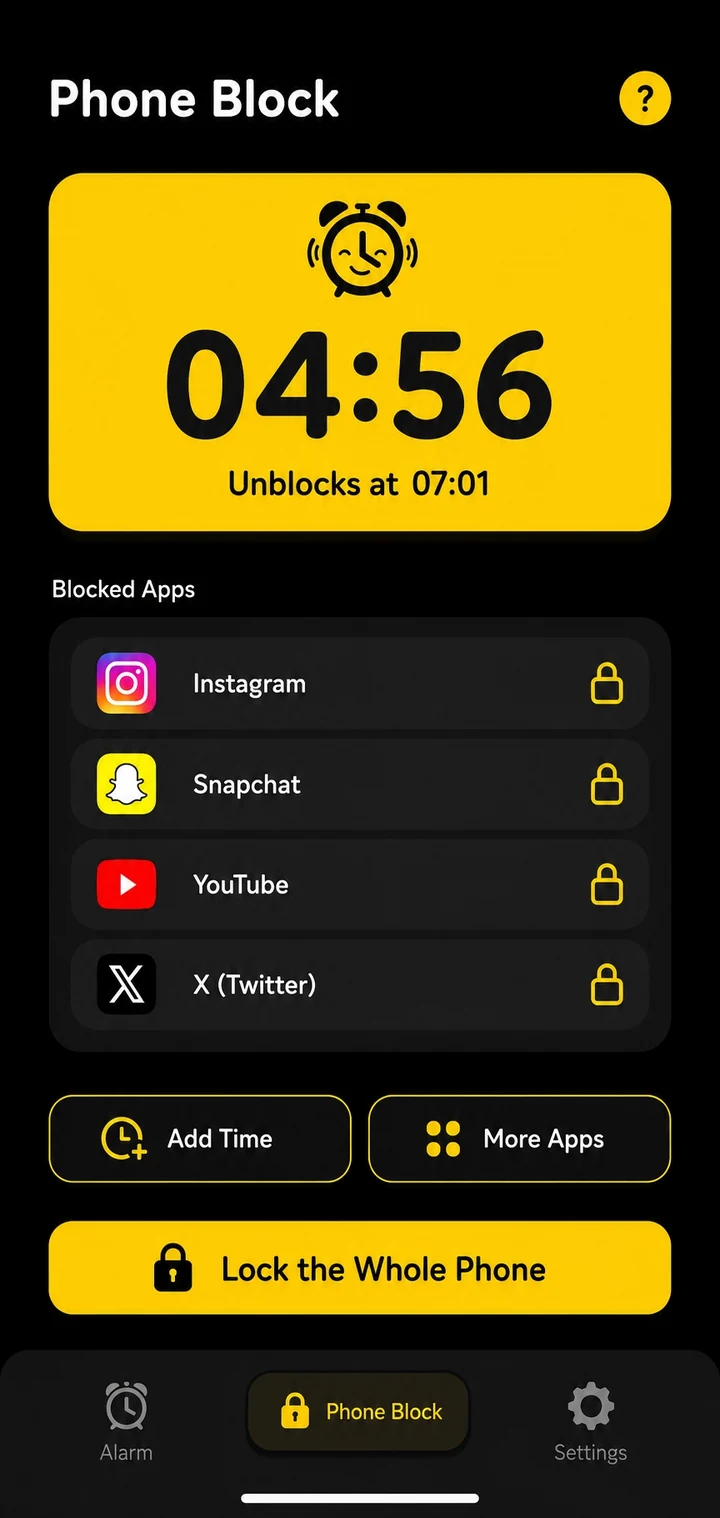
Beyond Alarm does this part for you: the alarm will not switch off until you have actually moved, and the apps you pick stay locked afterwards.


The one experiment that did beat habituation
Go back to the construction study, because its actual result is the most useful thing in this whole area.
Chae et al. tested a conventional probe tone against three alternatives: a sound resembling a threat, the participant's own name, and both together. The recommendation they landed on was the own-name signal.
Read that carefully. What defeated habituation was not a different sound. It was a meaningful one. Novelty lost; salience won.
Which reframes the whole tone-rotation ritual. Cycling through six ringtones gives your brain six things that mean the same nothing. The reason your name cut through is that it carries a demand — something is being asked of you specifically — and that is a property no ringtone has, however new it is.
This is also why the fifteen seconds after the alarm matter more than the alarm. A sound can only ask. It cannot check. And a half-awake person will dismiss it with no memory of having done so, because during those fifteen seconds the part of you making decisions is not fully online yet.
What to do tomorrow
| Evidence behind it | Worth doing? | |
|---|---|---|
| Sleep longer, more consistently | Overwhelming | Yes, and it is the boring answer for a reason |
| Treat the anxiety keeping you up | Strong, newly quantified | Yes — biggest single number in the 2026 data |
| Put the phone across the room | Indirect but mechanical | Yes, and free |
| A melodic tone over a harsh one | One 50-person survey | Sure, it costs nothing |
| Rotating your tone every 3 weeks | None in sleeping people | Harmless, but stop expecting it to fix this |
| Making the alarm require something | Untested on this question; the closest evidence says demand beats novelty | This is where the leverage is |
Also worth ruling out first: if your alarm is genuinely making no sound rather than being ignored, that is not habituation, it is your phone killing the alarm to save battery, and it is fixable in about four minutes.
And if you are reverse-engineering bedtimes from a cycle calculator to wake at a "good" moment, that arithmetic does not hold up either.
The reverse case is worth knowing too. If you sometimes surface a few minutes before the alarm, that is the same mechanism running in your favour — and the popular explanation for it, that your body released cortisol to meet the alarm, turns out to rest on a study of fifteen people who had no alarm clock.
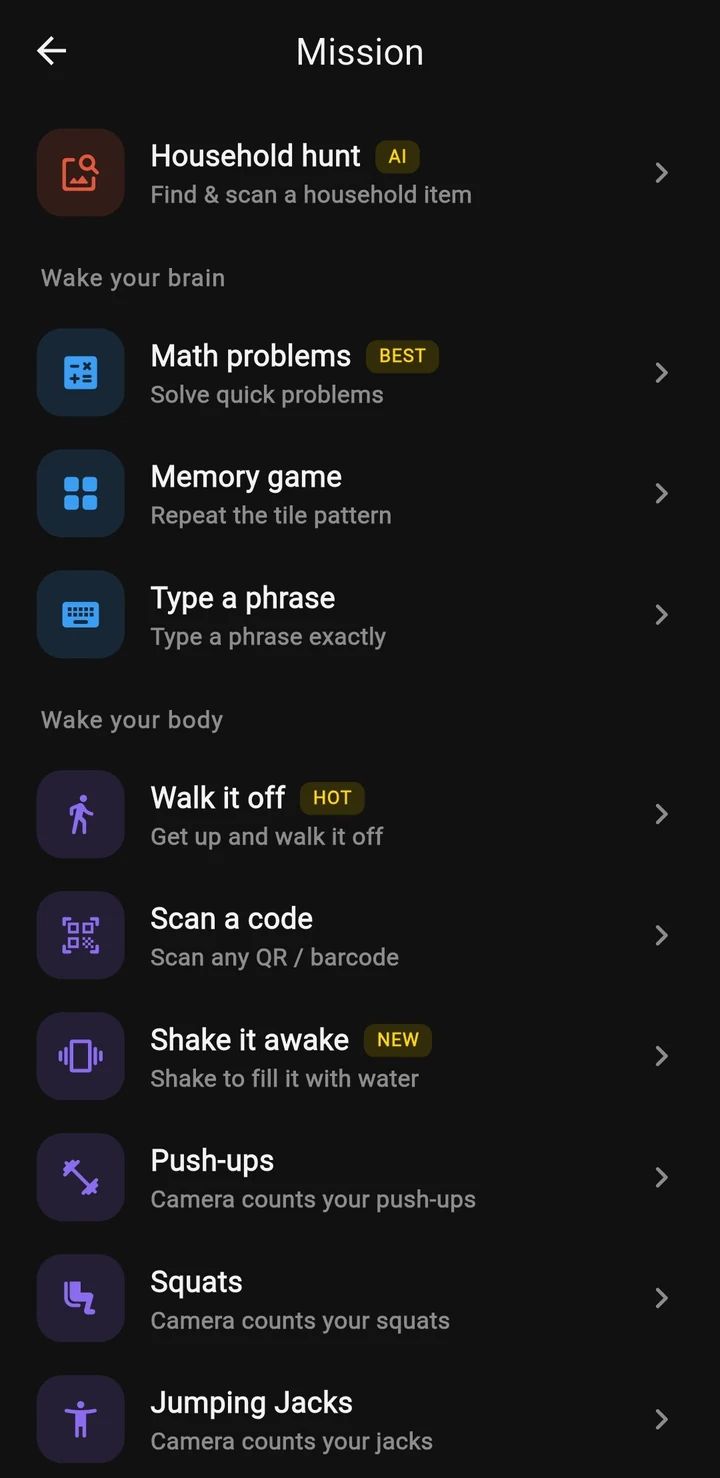
This is the reasoning behind how Beyond Alarm dismisses. It does not try to out-shout habituation with a new tone — it makes the alarm ask for something a horizontal person cannot supply: a set of squats, a photo of a room you have to walk to, a maths problem. That is the same principle the construction study landed on, applied to the one place it has not been tested. We will say plainly that our version has not been through a lab either. What it has is a mechanism that does not depend on you being alert enough to make a good decision at 6am, which is the assumption every sound-based alarm quietly makes.
The short version: stop tuning the sound. It is the only variable that is easy to change, which is why it absorbs all the attention and all the blog posts, and it is the one the evidence has the least to say about.
The alarm was never the hard part. The fifteen seconds afterwards are, and no choice of ringtone has ever done anything about those. If you want an alarm that puts something in those fifteen seconds, the options are compared here.
Common questions
Do you really get used to your alarm sound over time?
Nobody has measured it in a sleeping person. The 2020 systematic review of alarm sounds and morning grogginess covered 12 studies from 1992 to 2020 and did not examine adaptation over time at all. Habituation is real as a general property of the nervous system, but "your alarm tone specifically stops working after a few weeks of use" is an untested extrapolation, not a finding.
Should I change my alarm tone every few weeks?
It costs nothing, so there is no reason not to, but do not expect much. The one experiment that actually beat habituation to a repeated warning did not do it with a new sound — it did it with a meaningful one, the listener's own name. Novelty was not what worked. Salience was.
Why does my alarm work some mornings and not others?
Far more likely to be the state you are in than the sound. A 2026 study of 2,355 people found anxiety was associated with 14.3 minutes of extra morning grogginess, with a late chronotype, insomnia and short sleep all pushing the same direction. Those vary night to night. Your ringtone does not.
Does a louder alarm help?
Up to a point, and then it stops. Volume raises the chance you surface at all, but it does nothing about the ten to twenty minutes after that, which is when the alarm gets dismissed. Louder gets you awake; it does not get you upright.
My alarm genuinely does not make a sound some mornings. Is that this?
No, that is a different and more fixable problem. On Xiaomi, vivo, OPPO and realme phones, aggressive battery optimisation kills scheduled alarms outright. If yours is silent rather than ignored, start there instead.
What actually reduces the odds of sleeping through it?
Total sleep and a consistent wake time, both of which are dull and both of which are better supported than anything about tone selection. After that, make the alarm require something a half-asleep person cannot do lying down.
We build Beyond Alarm, an Android alarm app that will not switch off until you have actually moved. Most of what we write here comes out of problems we hit building it.
Beyond Alarm
An alarm that keeps ringing until you’ve actually moved — then blocks the apps that pull you back to bed. Free to start, no account.
Keep reading
The alarm that makes you take a picture — how photo alarms decide you're in the right place
A photo alarm stops only when you photograph a place you chose the night before. How the phone decides it's the same place, which spots work best, and why a good one gets more forgiving, not less.
Push-up alarm on Android — how it works, and how to set it up so it actually gets you up
A push-up alarm only stops when the camera has counted your reps. How the counting works, where to put the phone, how many reps to set, and the permission setting that quietly breaks it.