
Why you turn off your alarm in your sleep and don't remember it
 Beyond Alarm10 August 2026 · 7 min read
There is a specific, disorienting experience that a lot of people quietly think is a personal failing: waking up long after your alarm, checking your phone, and seeing that you dismissed it yourself — with no memory whatsoever of having done so.
It feels like evidence that you are undisciplined. It isn't. It is a predictable consequence of how waking up actually works, and the reason most advice about it fails is that the advice assumes there is a you present to make a decision. For the first stretch after an alarm sounds, there mostly isn't.
Sleep inertia, briefly and properly
The transition from sleep to wakefulness is not a switch. It is a gradual process, and the groggy period in between has a name: sleep inertia.
It is well studied. The review literature puts the typical experience at 15 to 30 minutes after waking, with the strongest effects in the first 15, and notes it can run longer under sleep debt or after waking from deep sleep.
During it, your brain is measurably not yet running at capacity. The prefrontal regions responsible for executive function take longer to return to baseline than the parts handling movement and reflex.
The gap is not uniform either. Research on how sleep inertia dissipates finds that tasks needing complex cognition are hit harder than simple motor ones. So for a window after waking, you have a body that can reach out and tap a screen, attached to a decision-making system that is still booting.
That combination explains the memory gap exactly. Forming a memory you can recall later is a function of systems that are still offline. Reaching for a phone and hitting a large button is not.
So the tap happened. You were just not sufficiently awake to record it.

Two things make it worse, and both are common:
- Waking during deep sleep. Sleep inertia is more severe if the alarm catches you in a deep stage rather than a light one. This is also why short naps feel different: sleep episodes under about 20 minutes produce little cognitive impairment, because there is not enough time to reach slow-wave sleep.
- Sleep debt. Chronically under-slept people experience longer and heavier inertia. If you are running a deficit, this gets harder every day.

What comes back online, and when
| Faculty | State in the first minutes | What that means at 6am |
|---|---|---|
| Movement and reflex | Largely available | You can reach out and tap |
| Impulse control | Still returning | The tap is not really a choice |
| Memory formation | Still returning | You will not remember doing it |
| Planning and judgement | Slowest to return | Bargaining with yourself fails |
Why more alarms make it worse
The intuitive fix is more alarms. It backfires, for two reasons.
First, you teach yourself that alarms are negotiable. If the 6:00 one has no consequence because 6:10 exists, the 6:00 one stops meaning anything — and your half-asleep brain learns that faster than your awake one does.
Second, and worse, you fragment the end of your sleep. The stretch between your first alarm and your last is not rest. You are cycling into light sleep, being pulled out, and dropping back — which tends to leave you feeling worse than if you had simply got up at the first one, and extends the inertia rather than shortening it.
Worth separating the two things that get lumped together here: a single snooze has been measured in a laboratory and comes out surprisingly well, while a stack of alarms across an hour has never been tested at all — which is a distinction with consequences.
Why "just put the phone across the room" only half works
This is the most common advice, and it is genuinely better than nothing, because it forces one thing that matters enormously: standing up.
Getting vertical does more to end sleep inertia than almost anything else. Blood pressure adjusts, you move, light hits your eyes, and the whole system starts coming up.
The problem is what happens next. Plenty of people cross a room, turn the alarm off, and get back into bed — because the walk took eleven seconds and none of them required a decision. The obstacle was physical, and the half-awake brain is perfectly capable of solving physical obstacles on autopilot.
What defeats sleep inertia is not distance. It is a task that cannot be completed on autopilot.
Beyond Alarm
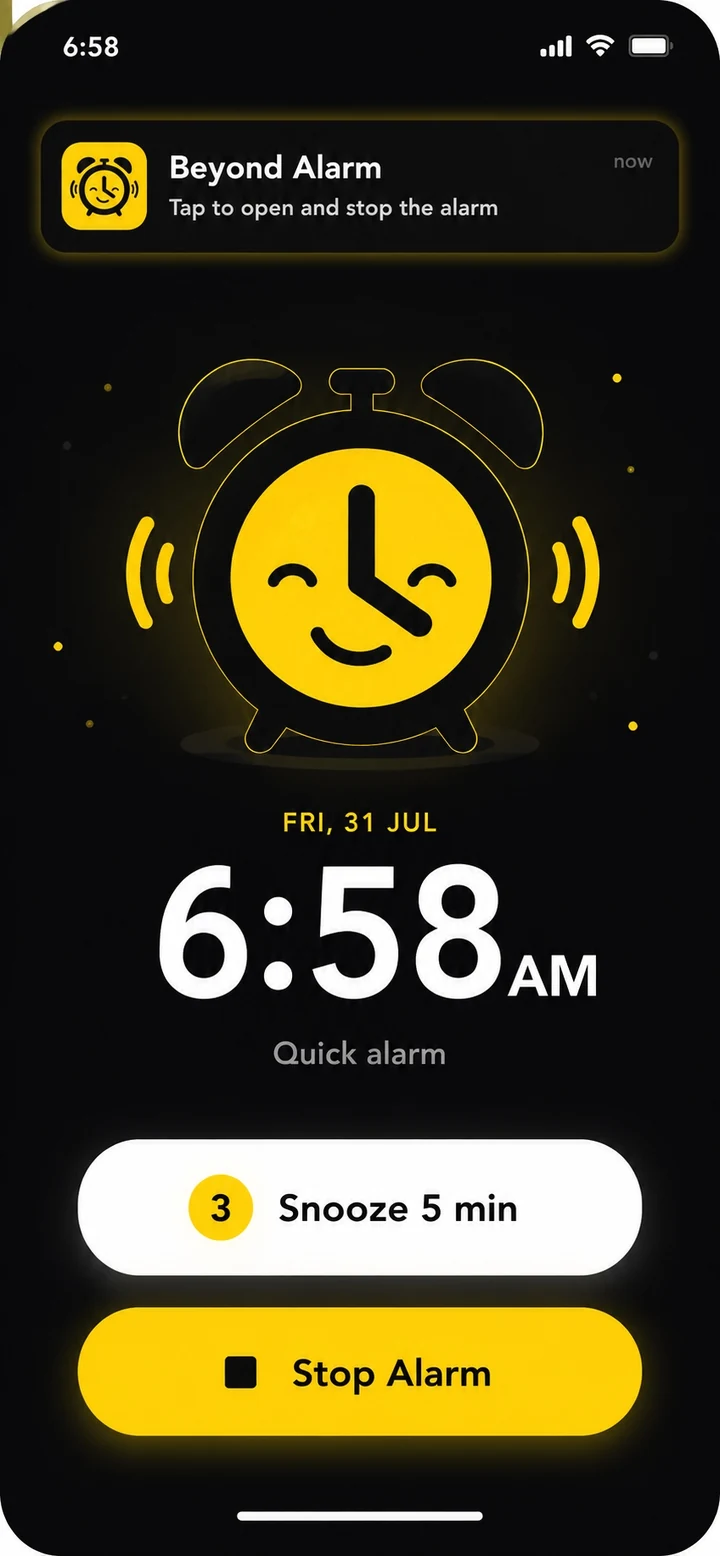
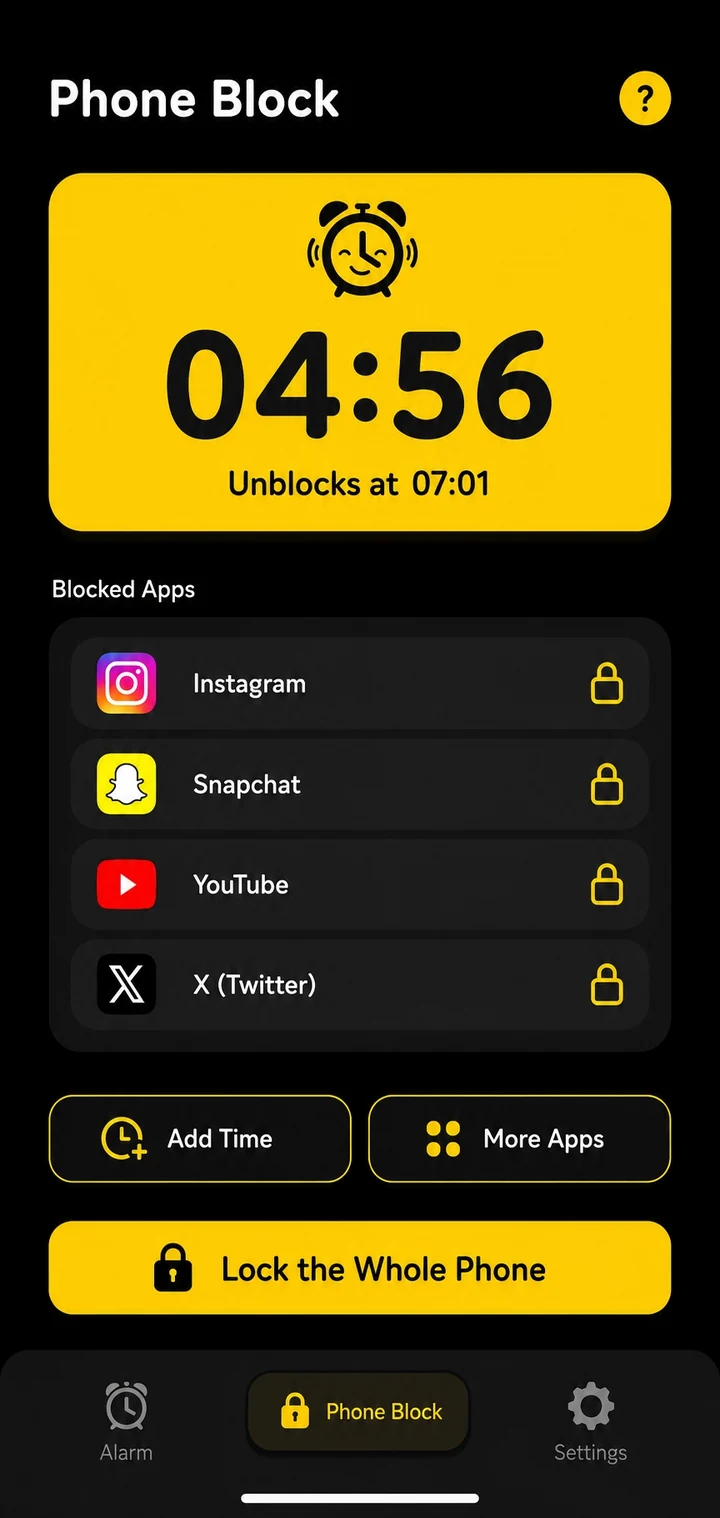
Beyond Alarm does this part for you: the alarm will not switch off until you have actually moved, and the apps you pick stay locked afterwards.


What actually works
In rough order of how much difference they make:
Fix the input, not just the exit. Nothing here beats being less sleep deprived. If you are chronically short, every trick below is you fighting a problem you are also causing.
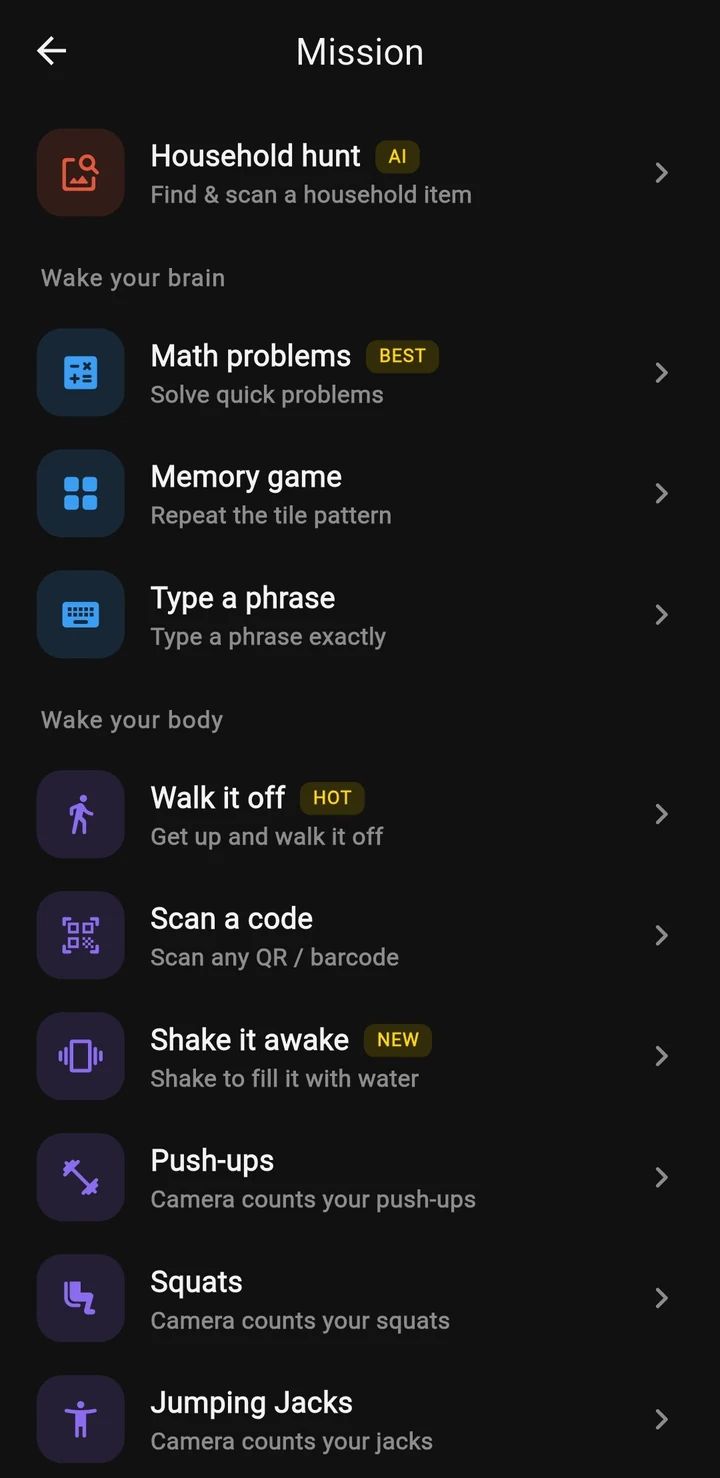
Make dismissing the alarm require thought, not motion. This is the core of it. Something you cannot do while asleep — solving a problem, counting reps, finding a specific object in another room. Not a bigger button. Not a longer swipe. Something with a correct answer, which a sleeping brain cannot produce.
One thing we learned building this: the task has to have a way out that is not giving up. Our own ring screen falls back to a maths problem when a camera mission cannot proceed — bad light, no room to stand — because a person trapped by their alarm at 6am will simply force-stop the app, and then you have taught them the alarm is beatable. Difficulty is the point; dead ends are not.
The other half of that is whether the task can be faked at all — a camera mission that counts push-ups you did not do is a dead end of a different kind, and worth two minutes of your time to check.

Get light on your face early. Light is the strongest signal your circadian system has. Curtains open, or a lamp on a timer, or outside within a few minutes.
Get vertical and stay vertical for two minutes. Most relapses happen inside the first thirty seconds. If you can hold standing for two minutes, inertia has usually receded enough that going back to bed becomes a choice rather than a reflex.
Do not check your phone yet. The single most reliable way to lose the next forty minutes is to sit back down on the edge of the bed with a feed open — the reason that happens is worth understanding on its own. Being upright is not the same as being awake; a scroll can put you straight back under. If the phone is also your alarm, so it cannot simply leave the room, that constraint changes which fixes are available.
Keep the wake time steady, including weekends. A consistent schedule reduces inertia over weeks. A two-hour weekend shift reproduces something very like jet lag by Monday.
The "make it require thought" principle is the entire idea behind Beyond Alarm: the alarm does not stop until you have done something a sleeping brain can't fake — a set of push-ups counted by the camera, a maths problem, finding a specific object in the kitchen. It is the across-the-room trick, except you cannot complete it on autopilot and get back into bed.
What to try tomorrow
Pick one, not all of them:
- One alarm. Delete the backups. They are costing you more than they save.
- Set it later. If you routinely lose 40 minutes to snoozing, you are not getting up at 6:00 anyway. Set 6:40 and get up at 6:40. A real wake time you honour beats an aspirational one you don't.
- Add a task you cannot autopilot — whatever form that takes. The apps that do this, and which of their missions can still be finished lying down, are compared here.
- Light before phone. Curtains first, screen second — the reasoning behind that ordering, and what else is worth doing in the first ten minutes, is ranked honestly here.
If your alarm is not going off at all, that is a separate and very fixable problem — see why alarms fail on Xiaomi, vivo, OPPO and realme phones. And if it rings but has stopped working on you, the popular fix — change your tone, you have habituated — has less behind it than it sounds. The opposite experience, waking a few minutes before it goes off, has a better-known explanation that also does not survive checking. And if your way out has become switching the phone off or uninstalling the app mid-ring, here is how to close that loophole.
And the reframe worth keeping: you are not failing to wake up. You are being asked to make a decision at the exact moment you are least equipped to make one. Any fix worth having is one that removes the decision — not one that demands more discipline from a brain that hasn't finished starting up.
Common questions
How long does sleep inertia last?
Commonly cited figures run from about 15 to 30 minutes, though it can persist longer after waking from deep sleep or when carrying significant sleep debt. The first few minutes are the most severe, which is exactly when the alarm asks you to make a decision.
Is snoozing actually bad for you?
The evidence on harm is mixed, but the practical case against it is strong. The time between alarms is fragmented light sleep rather than rest, and repeated alarms teach you that the first one is negotiable.
Why do I wake up tired after eight hours?
Sleep duration is only one factor. Waking mid-cycle from deep sleep produces heavier inertia than waking from light sleep after the same total hours, and an irregular schedule makes that more likely.
Does putting the phone across the room work?
Partly. It forces you to stand, which genuinely helps. But the walk takes about ten seconds and requires no decisions, so a half-asleep brain can complete it and return to bed on autopilot.
We build Beyond Alarm, an Android alarm app that will not switch off until you have actually moved. Most of what we write here comes out of problems we hit building it.
Beyond Alarm
An alarm that keeps ringing until you’ve actually moved — then blocks the apps that pull you back to bed. Free to start, no account.
Keep reading

Alarm app with missions — how the category works, and which mission actually fits you
A mission-based alarm forces a task instead of a tap. Here's why that mechanism works, the mission types across the category, and how to pick one that can't be beaten from bed.

Best free alarm app for heavy sleepers
A loud alarm isn't the hard part for a heavy sleeper — staying awake once it's off is. What actually works, free, and why a mission has to be hard to fake from bed to count.