
Why five alarms is worse than one snooze
 Beyond Alarm22 August 2026 · 7 min read
Snoozing has been studied properly, and it is not the villain the internet made of it. Thirty minutes of snoozing cost about six minutes of sleep and improved performance on three of four cognitive tests taken on rising. Stacking five alarms across an hour is a different behaviour, and nobody has measured it at all.
That distinction is missing from almost everything written on this subject, which is a problem, because the two are usually discussed as if they were the same habit with different spellings.
What the research actually measured
Every study you have seen quoted on snoozing measured a bounded window: one alarm, a snooze button, and something in the range of ten to thirty minutes.
The largest description of the behaviour comes from Robbins and colleagues in Scientific Reports, 2025, who looked at more than three million nights logged by users of a sleep tracking app. 55.6% of sleep sessions ended in a snooze alarm. The average was 2.4 presses and 10.8 minutes.
Around 45% of the people in that sample snoozed on more than 80% of mornings. The heaviest users averaged about twenty minutes a day.
Two details in that dataset are worth holding onto. Snoozing was highest Monday to Friday and lowest at the weekend — and long sleep sessions, over nine hours, were more likely to end in a snooze than short ones.
That second one should bother anyone who believes snoozing is simply a symptom of not sleeping enough. It is at least as much a symptom of being woken at a time your body did not choose.
What a snooze actually costs
The careful experiment is Sundelin, Landry and Axelsson, 2024, in the Journal of Sleep Research. They surveyed 1,732 people — 69% snoozed at least sometimes — and then brought 31 habitual snoozers into a laboratory with full polysomnography.
Each person was measured twice: once allowed a 30-minute snooze, once made to get up at the first alarm.
Snoozing cost about six minutes of sleep. On the tests taken immediately on rising, the snooze mornings were better on three of four — arithmetic speed, episodic memory, and the Stroop conflict cost — with working memory showing no difference.
There was no clear effect on the cortisol awakening response, on mood, on morning sleepiness, or on the shape of the night's sleep.

The mechanism is the interesting part. No participant reached slow-wave sleep during the snooze period, while 30% did when left to sleep through.
Waking out of deep sleep is what produces the heaviest grogginess — it is the same reason you can turn an alarm off with no memory of doing it — or, if the alarm asks for press-ups, have them counted without doing any. A short snooze window was, in effect, holding people in light sleep until the time they actually meant to get up.
Two honest limits. Thirty-one people is a small study, all of them already habitual snoozers, and the episodic memory benefit had disappeared by 40 minutes. That number is the closest thing the literature gives us to a boundary.
The two behaviours, side by side
| One alarm plus snooze | Five alarms across an hour | |
|---|---|---|
| Typical window | 10–30 min (2.4 presses, 10.8 min average) | 45–90 min |
| Sleep stage reached between alarms | Light only — no participant reached N3 | Long enough to fall back into deeper stages |
| Measured in a laboratory | Yes, with polysomnography | Never |
| Effect on cognition on rising | Better on 3 of 4 tests | Unknown |
| Decision made each time it fires | None — the decision was made once | A fresh one, while least able to make it |
The last row is the one that does the damage, and it is behavioural rather than physiological, so treat it as reasoning rather than a finding.
A snooze button is a single decision you already made. The alarm at 6:40 that exists because you did not trust the one at 6:00 is a negotiation, and it arrives at the exact moment your judgement is at its weakest.
Why the stack gets worse, not better
Three things separate a stack from a snooze, and none of them are about willpower.
The window is long enough to matter. Ten minutes cannot take you back into slow-wave sleep. An hour can — and an alarm that catches you there produces worse inertia than the one that woke you in the first place.
Each alarm teaches the next one to mean less. If 6:00 has no consequence because 6:10 exists, 6:00 stops being a wake time and becomes a suggestion. The half-asleep version of you learns this considerably faster than the awake version does.
The stack hides the real number. Someone with alarms at 6:00, 6:15, 6:30 and 6:45 does not get up at six. They get up at 6:45, having spent forty-five minutes generating fragmented sleep instead of forty-five minutes of the real thing.
Beyond Alarm
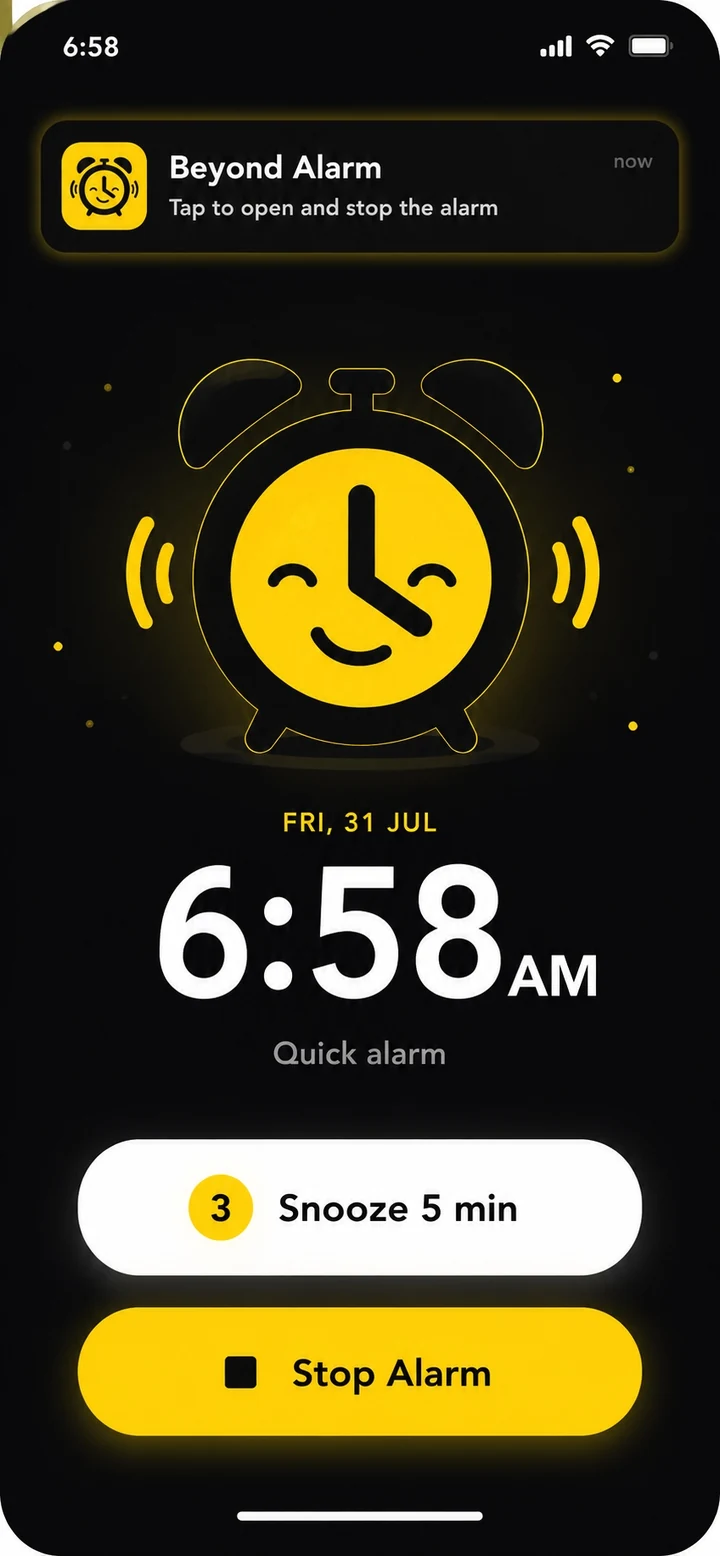
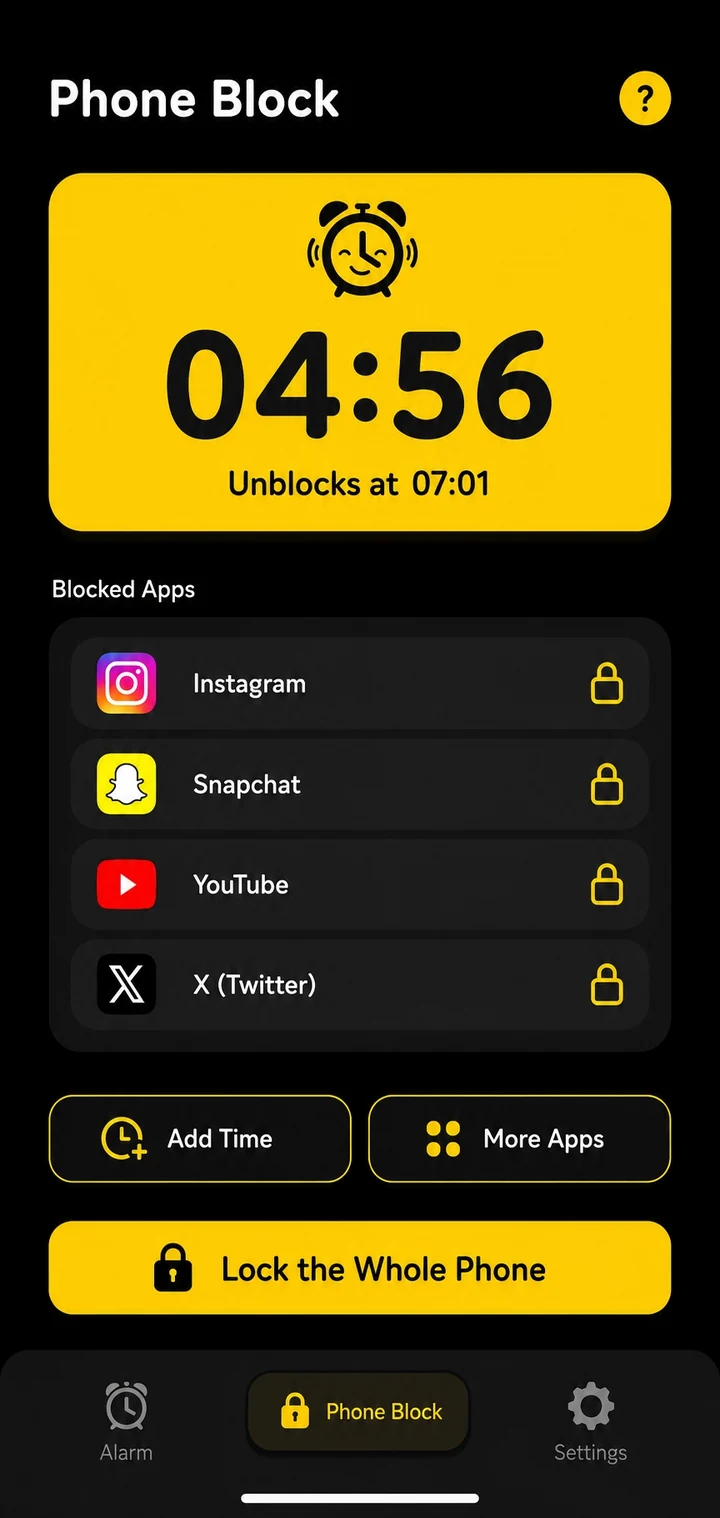
Beyond Alarm does this part for you: the alarm will not switch off until you have actually moved, and the apps you pick stay locked afterwards.


What nobody has tested
It would be easy to end this by telling you five alarms are proven harmful. They are not, and the gap is worth stating plainly.
No study has compared stacked independent alarms against a single alarm with snooze. The closest evidence is Mattingly and colleagues in Sleep, 2022, who tracked 450 people and found that snoozers spent 2.19% more of their final hour in light sleep and 1.86% less in deep sleep.
That same study found something inconvenient for the standard lecture: snoozers did not sleep less overall than non-snoozers. What differed was the texture of the last hour, not the total.
So the honest position is that snoozing is defensible, stacking is probably worse for mechanical reasons, and anyone stating either as settled science is ahead of the evidence.
What to do tomorrow morning
In rough order of how much difference it makes.
Set one alarm, at the time you actually get up. Not the aspirational time. If the stack always ends at 6:45, the alarm is a 6:45 alarm, and setting it there converts fragmented sleep into real sleep at no cost to your morning.
Not a time worked backwards from a multiple of 90, either — sleep cycle calculators do not survive contact with real sleep cycles.
If you snooze, bound it. One cycle, not an hour. The evidence supports a short window for habitual snoozers and gives you no reason to believe a long one is harmless.
Fix the input before the exit. Nothing here beats being less sleep deprived, and a stack of alarms is frequently just the bill for where the previous night went.
Try the free things first. A sunrise lamp, curtains open, the phone across the room, and a wake time that does not move by two hours at the weekend. If all you need is a louder alarm, your phone's built-in clock app is fine and costs nothing.
If none of that works, the problem is not the number of alarms. It is that every one of them can be dismissed by a hand attached to a brain that is not yet awake. What defeats that is a task with a correct answer — something a sleeping person cannot produce.
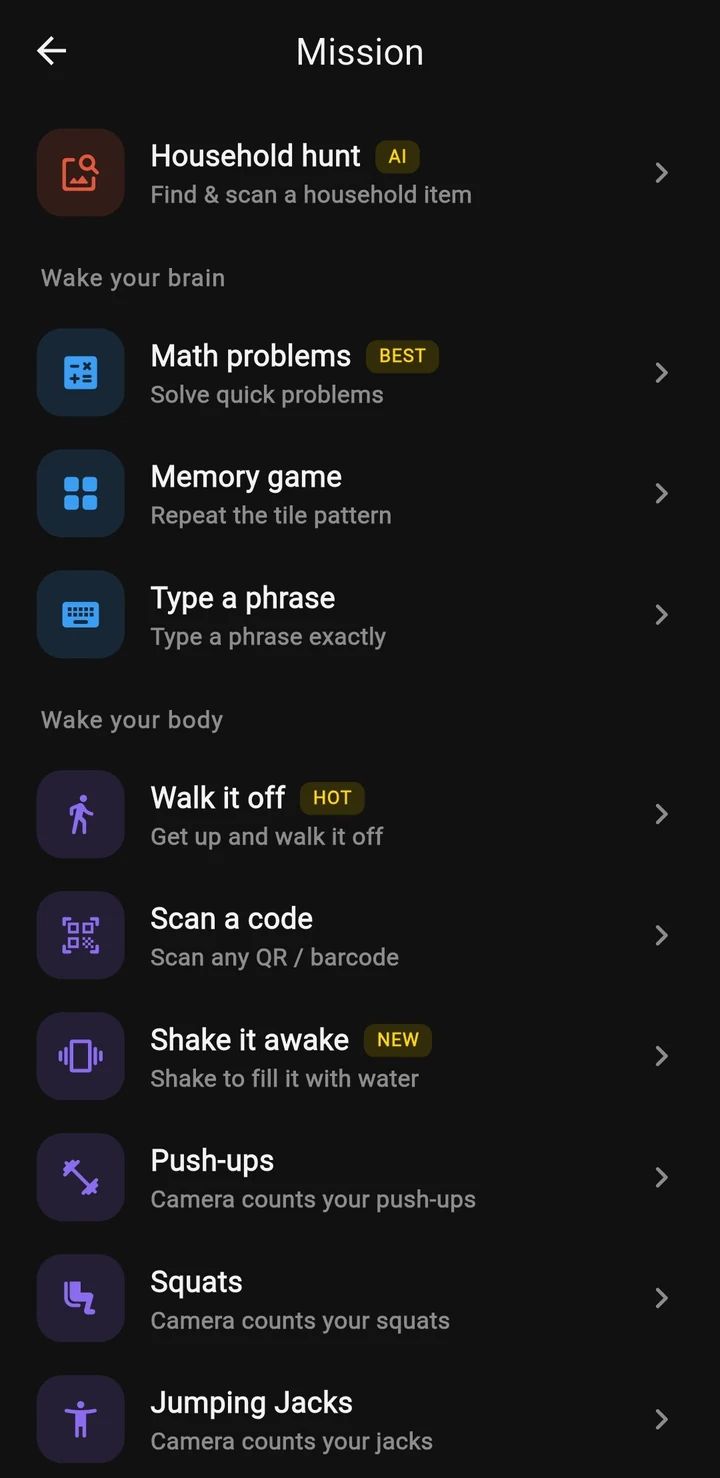
This is why Beyond Alarm allows snooze but will not let it become a stack. The default is five minutes, three times, and after that the wake-up mission is mandatory — push-ups counted by the camera, a maths problem, an object to find in another room. The bounded window the research supports is kept. The hour-long negotiation is the thing removed.
If your alarm is not going off reliably in the first place, that is a separate problem with a separate cause, and on many Android phones it is not your fault at all.
And if you have concluded that the alarm simply stopped working on you, the usual explanation — that you got used to the tone and should rotate it — turns out to rest on almost nothing measured in a sleeping person.
And if the conclusion you have reached is that you need one alarm you cannot negotiate with, these are the apps that offer that.
Common questions
Is it bad to set multiple alarms?
Probably, though nobody has tested it directly. Every study that exists measured snoozing — one alarm, a snooze button, a window of roughly 10 to 30 minutes — and found little harm. A stack of independent alarms spread over an hour is a different behaviour with a longer window, and the one boundary the research does give us is that the measurable benefit of snoozing disappeared after 40 minutes. Anyone telling you multiple alarms are proven harmful is going beyond the evidence, and so is anyone telling you they are fine.
Is hitting snooze actually bad for you?
On the best evidence available, no. Sundelin, Landry and Axelsson put 31 habitual snoozers through a sleep laboratory in 2024 and found that 30 minutes of snoozing cost about six minutes of sleep, improved performance on three of four cognitive tests taken immediately on rising, and had no clear effect on the cortisol awakening response, mood, morning sleepiness or overnight sleep architecture. The caveats matter — 31 people, all of them already habitual snoozers — but it is a real experiment, and it points the opposite way to the advice everyone repeats.
How many alarms should I set?
One, at the time you actually get out of bed rather than the time you wish you did. If you routinely lose forty minutes to a stack, you are not a person who gets up at 6:00 with a 6:00 alarm — you are a person who gets up at 6:40, and setting 6:40 buys you forty minutes of real sleep instead of forty minutes of fragmented sleep.
Why does snoozing sometimes make me feel better, not worse?
Because a short snooze window keeps you out of deep sleep. In the 2024 laboratory study no participant reached slow-wave sleep during the snooze period, while 30% did when left to sleep through — and waking out of slow-wave sleep is what produces the heaviest grogginess. The snooze was effectively holding them in a light stage until the real wake time.
Does snoozing mean I am not getting enough sleep?
It correlates with it, but it is not proof. In the 2022 Sleep study of 450 people, snoozers did not sleep less overall than non-snoozers — what differed was the texture of their final hour, which contained more light sleep and less deep sleep. Snoozing is more reliably a marker of being an evening chronotype on a schedule built for morning people.
What should I do instead of stacking alarms?
Set one alarm and give it something you cannot complete on autopilot — a task with a correct answer, or one that requires you to be standing up in another room. The stack is usually a workaround for not trusting the first alarm, and adding more of a thing you do not trust does not fix the trust problem.
We build Beyond Alarm, an Android alarm app that will not switch off until you have actually moved. Most of what we write here comes out of problems we hit building it.
Beyond Alarm
An alarm that keeps ringing until you’ve actually moved — then blocks the apps that pull you back to bed. Free to start, no account.
Keep reading
The alarm that makes you take a picture — how photo alarms decide you're in the right place
A photo alarm stops only when you photograph a place you chose the night before. How the phone decides it's the same place, which spots work best, and why a good one gets more forgiving, not less.
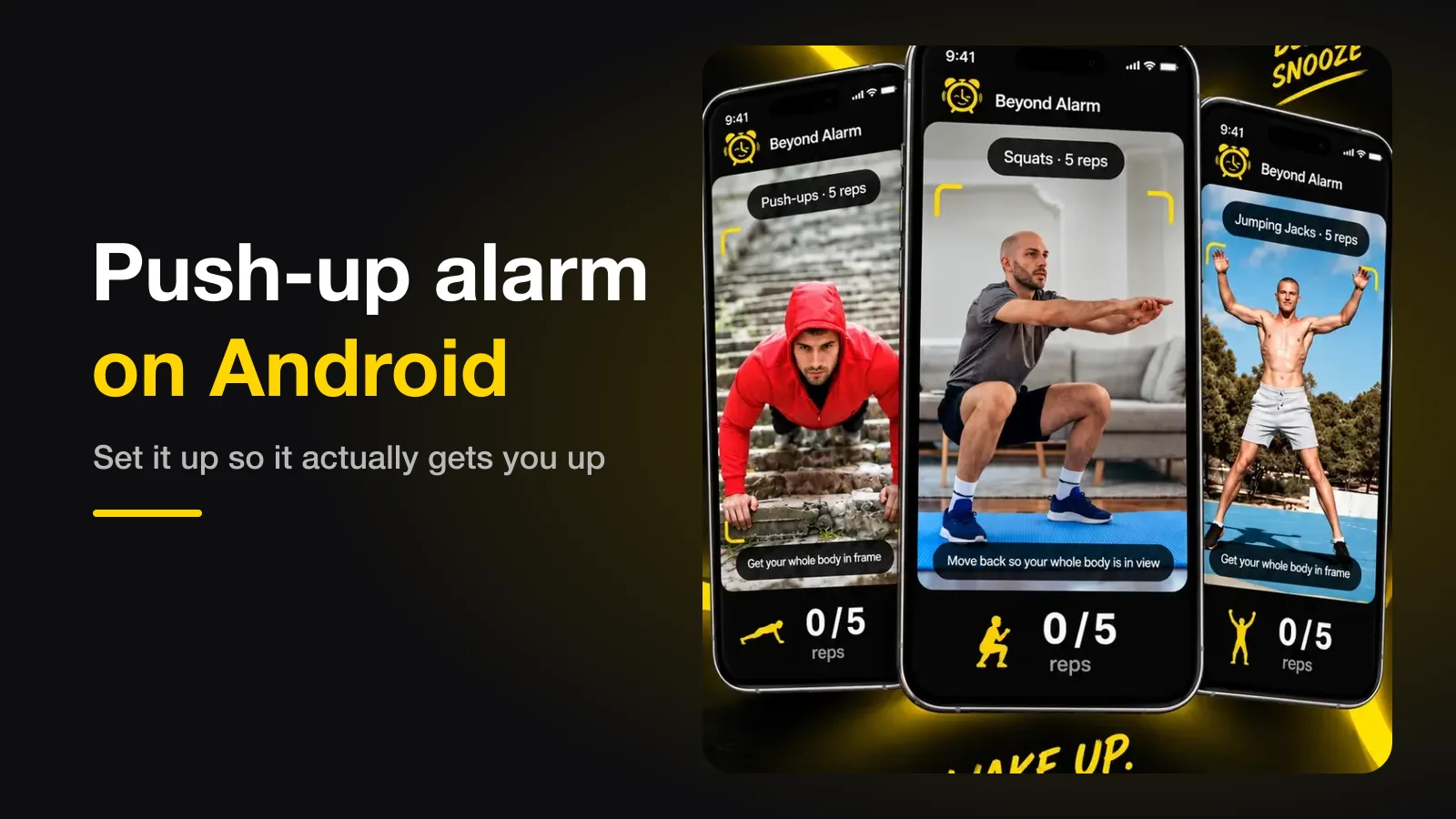
Push-up alarm on Android — how it works, and how to set it up so it actually gets you up
A push-up alarm only stops when the camera has counted your reps. How the counting works, where to put the phone, how many reps to set, and the permission setting that quietly breaks it.