
Best alarm for deep sleepers: what the science says
 Beyond Alarm17 November 2026 · 8 min read
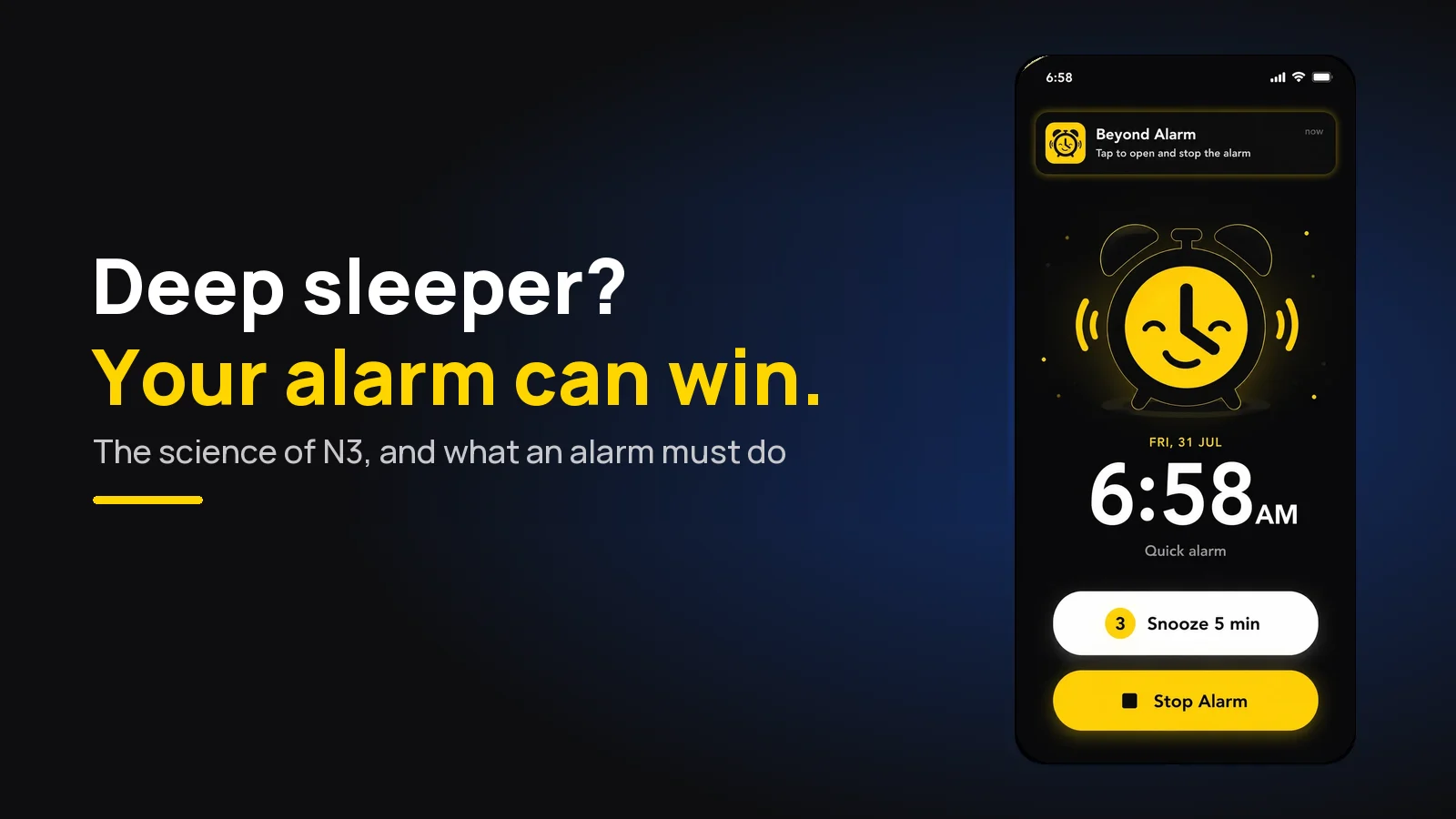
The best alarm for deep sleepers is one that keeps working after the first sound gets through, because deep sleep is where your brain is hardest to wake and quickest to forget. Beyond Alarm does that: it rings until you finish a mission you can't do in bed, then checks you stayed up.
The short version:
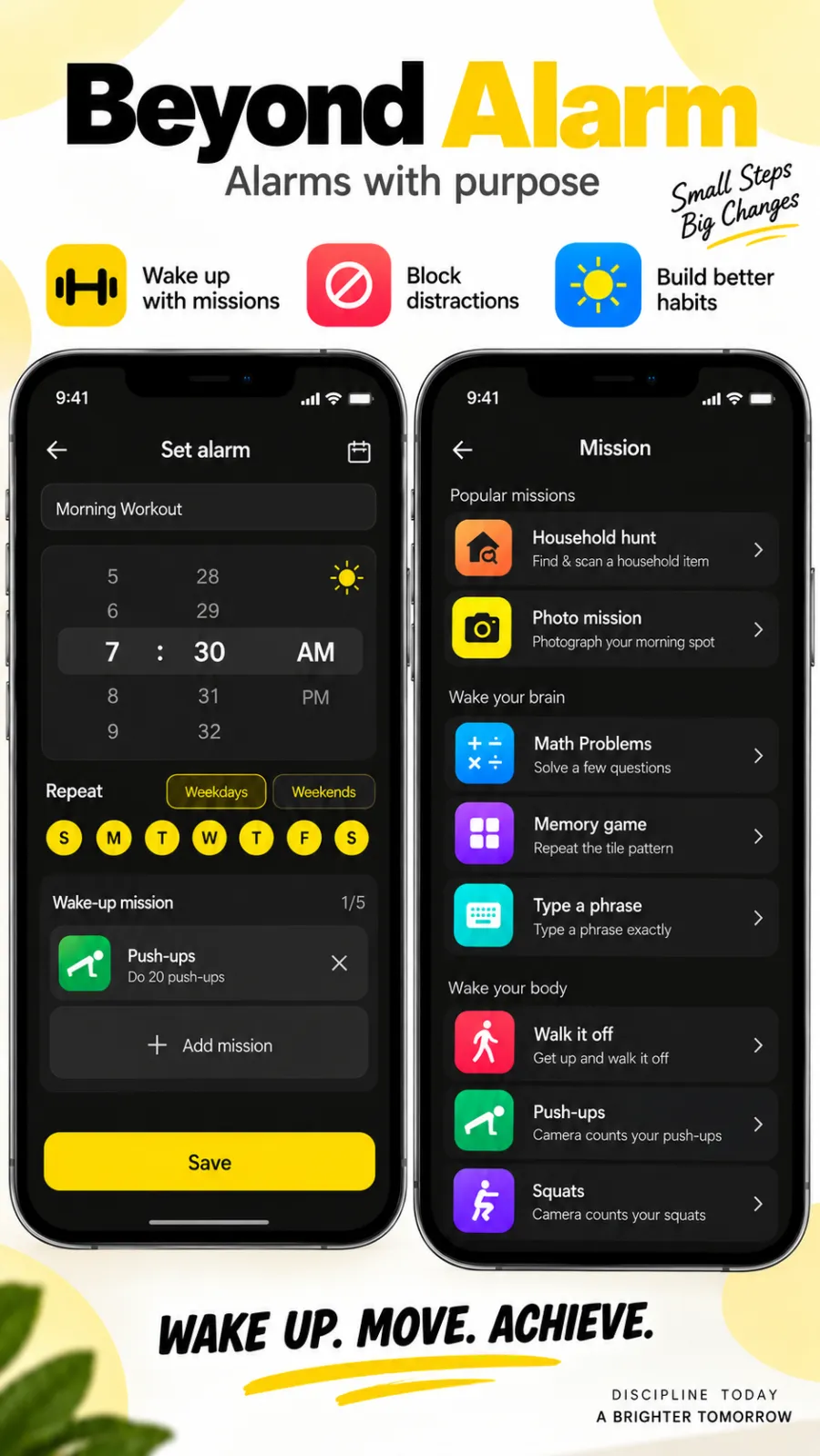
- Beyond Alarm is the pick for deep sleepers: 11 wake-up missions, up to 5 per alarm, Wake-up check on Android and Morning lockout, free on Android and iPhone.
- Deep sleep (stage N3) is the hardest stage to wake from, and it's packed into the first half of the night.
- Waking from it brings the heaviest grogginess, known as sleep inertia, which can take an hour or more to clear.
- Sleep around the moment you dismiss the alarm can wipe the memory of dismissing it. That's the alarm you "never heard".
- So a deep sleeper's alarm needs four things: it rings reliably, it needs a conscious task to stop, it outlasts the grogginess, and it stops you going back to bed.
Why deep sleepers don't hear the alarm (or don't remember it)
Sleep runs in cycles of light sleep (N1 and N2), deep sleep (N3) and REM. N3 is also called slow-wave sleep, after the slow delta waves that show up in the brain. The Sleep Foundation puts it plainly: "it's harder to wake someone up if they're in this phase."
Two details matter for an alarm. Early in the night, N3 stretches "commonly last for 20 to 40 minutes", and "you spend the most time in deep sleep during the first half of the night." REM takes over later, "especially in the second half of the night."
Then there's memory. In a 1994 study in Sleep (Wyatt, Bootzin and colleagues), people allowed ten minutes of sleep had poor recall of sounds played just before they dozed off. People woken after 30 seconds didn't have the same gap.
Put those together and you get the deep sleeper's morning. The alarm reaches you, a hand silences it, you're back under within minutes, and the memory of the whole thing is gone. We've covered that reflex in turning off your alarm in your sleep.
Waking from N3 vs REM: why the stage matters
The grogginess after waking is called sleep inertia. A 2019 review by Hilditch and McHill, Sleep inertia: current insights, gathers what's known about it, and the stage you wake from is a big part.
In one nap study they describe, people woken from slow-wave sleep "showed a 41% reduction in performance upon awakening", while people woken from N2 "showed similar performance to those who were already awake." Another found decision-making "significantly worse upon waking from SWS compared to REM sleep."
| Stage you wake from | When it's most common | How hard to wake | How you feel after |
|---|---|---|---|
| N3 (deep, slow-wave) | First half of the night | Hardest | Heaviest grogginess |
| N2 (light) | All night | Easier | Close to normal in the nap study |
| REM | Second half of the night | Easier than N3 | Less impaired than after N3 |
The same review adds three things a deep sleeper should know:
- "Sleep inertia is worse under conditions of prior sleep loss", and cumulative sleep loss makes it worse too.
- Effects "are greatest during the biological night", so a very early alarm hits harder.
- "Full recovery does not appear to be complete until at least an hour after awakening."
Who ends up waking from deep sleep
You're most likely to be pulled out of N3 when:
- The night is short. Fewer hours means the alarm lands nearer the deep-sleep-heavy first half.
- The alarm is very early relative to your body clock, which is also when sleep inertia peaks.
- You're young. A 2004 meta-analysis in Sleep (Ohayon and colleagues, 65 studies, ages 5 to 102) found the share of slow-wave sleep falls with age.
Can you just time the alarm to miss N3? Only roughly. Cycles vary from night to night, which is why we're sceptical of sleep cycle calculators. The practical answer is an alarm built to handle a deep-sleep wake-up when it happens.
Beyond Alarm
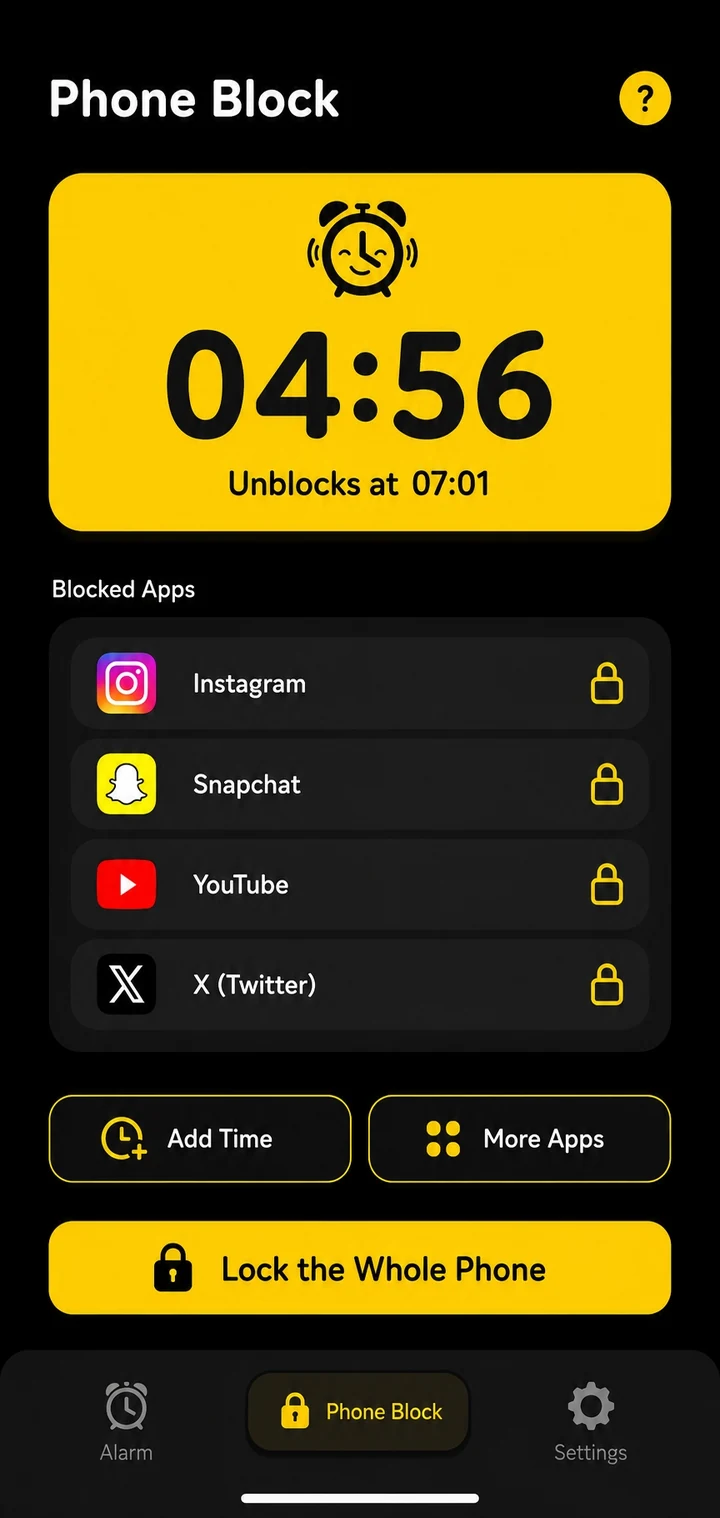
Beyond Alarm does this part for you: the alarm will not switch off until you have actually moved, and the apps you pick stay locked afterwards.


What an alarm for deep sleepers has to do
Here's how the science maps onto what Beyond Alarm does.
| The science | What the alarm must do | Beyond Alarm |
|---|---|---|
| N3 has the highest wake-up bar | Ring reliably, loud enough, for as long as it takes | AlarmKit on iPhone; no ring time-out on Android |
| Sleep can erase the dismissal | Need a conscious task to stop | 11 missions, up to 5 chained |
| Inertia can last an hour | Keep you moving, then check | Wake-up check, 1–10 min later (Android) |
| Back to bed is easy when groggy | Give you no reason to lie down with the phone | Morning lockout, 15–60 min or custom |
| Sleep loss makes inertia worse | Protect the night before | Phone Block, free Strict mode |
1. Ring, and keep ringing
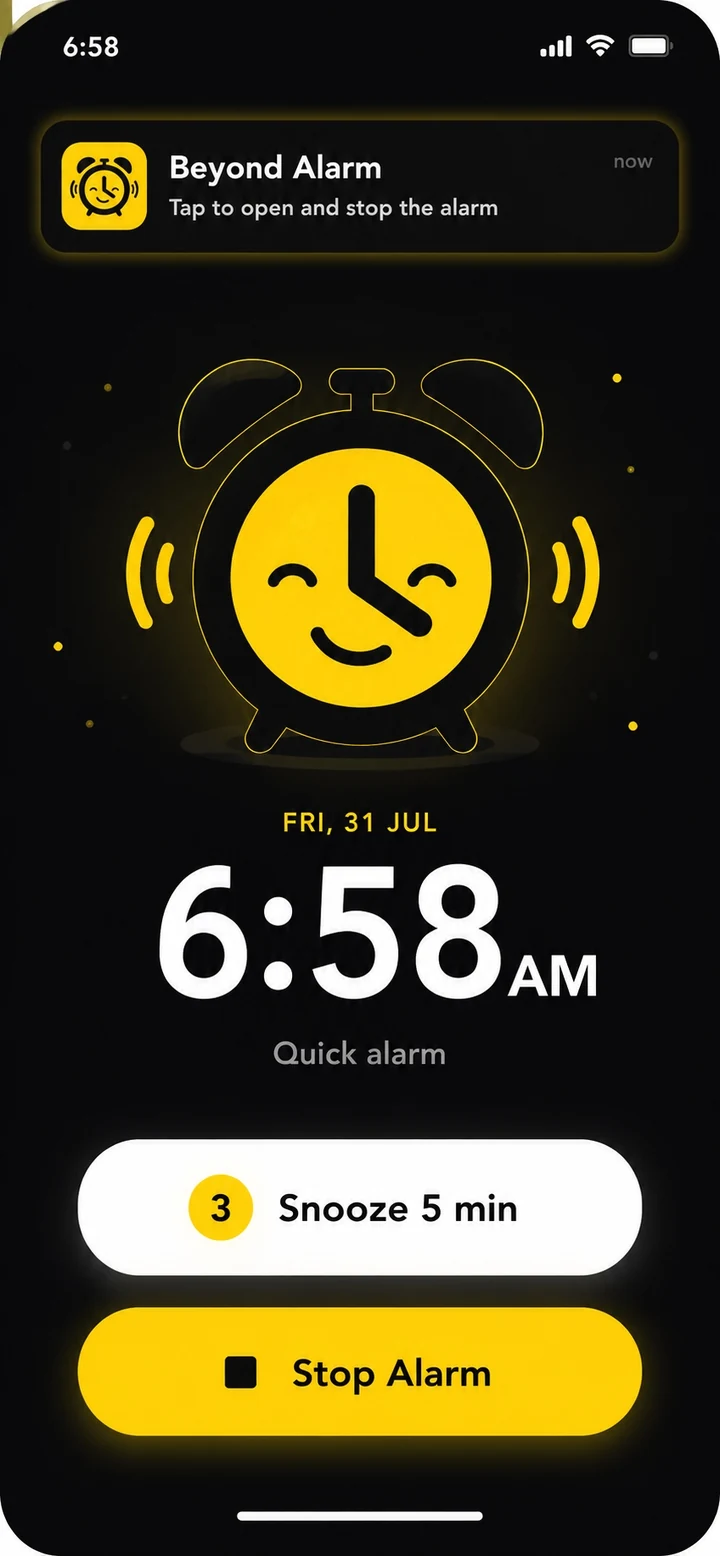
On iPhone, Beyond Alarm schedules through Apple's AlarmKit, whose alert, in Apple's WWDC25 session, "breaks through the silent mode and the current focus". On Android its ring has no time-out, and Beyond Alarm's Reliability screen checks the battery and autostart settings that silence alarms.
Pick a sound from the Loud category, or on Android add your own. The review notes one study where participants' preferred music "led to improved cognitive performance for up to 20 mins after waking", so a track you like is worth trying.
2. Make stopping it a conscious act
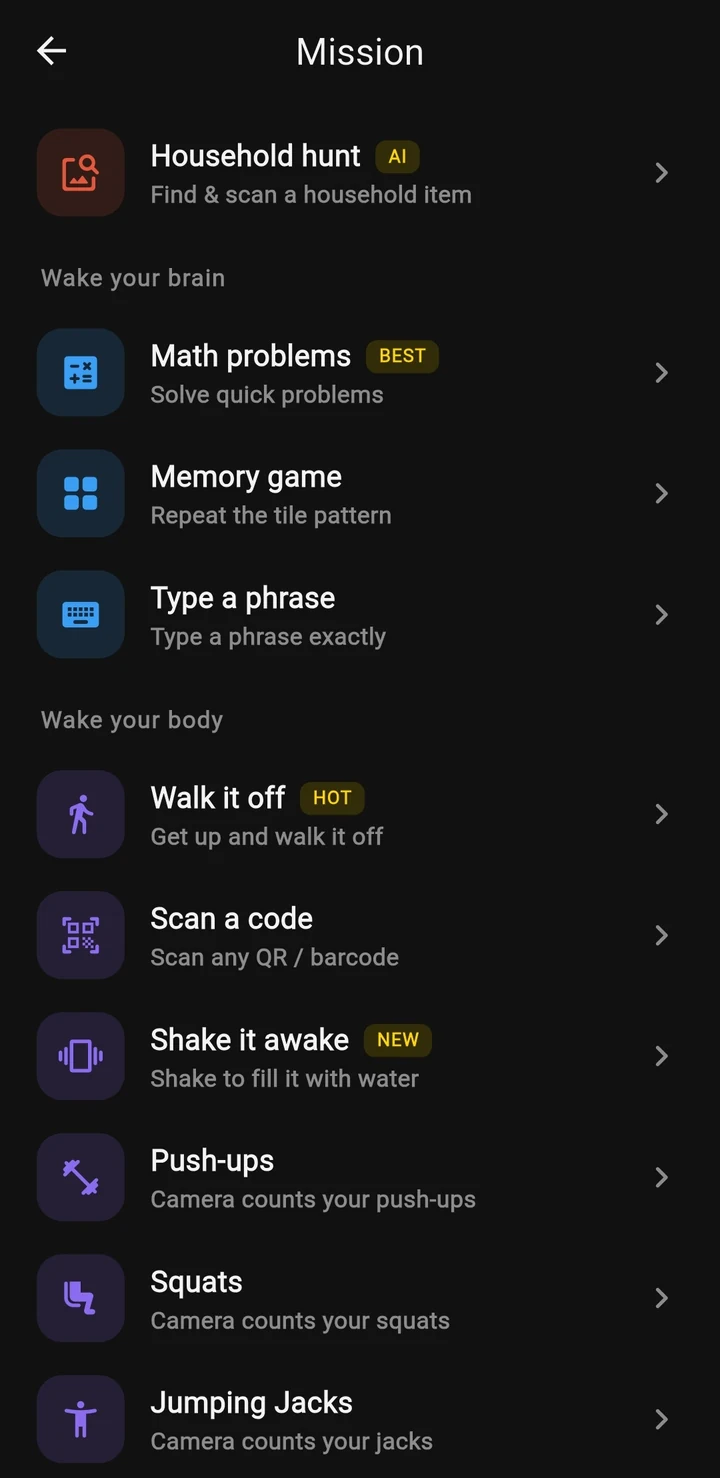
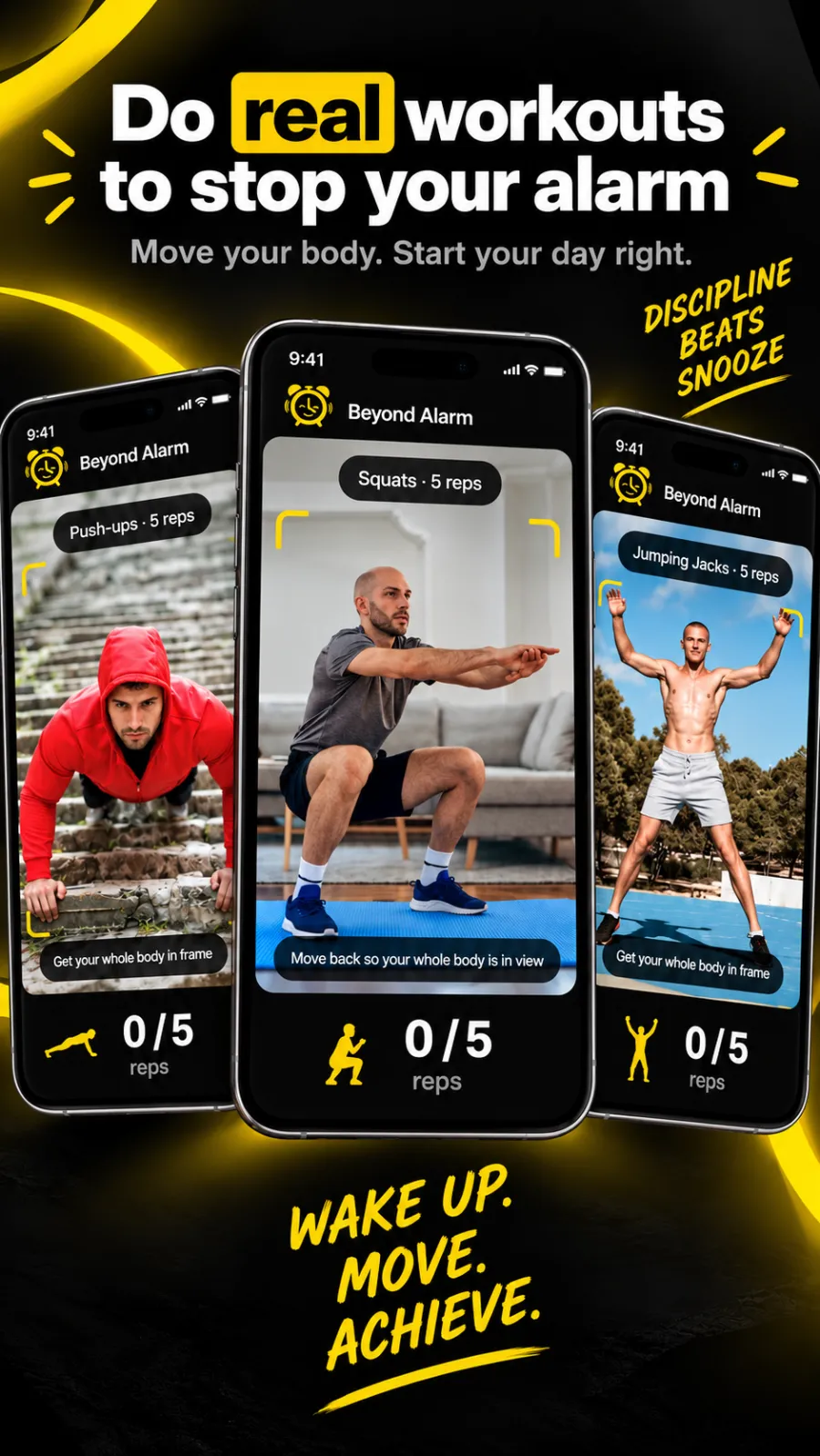
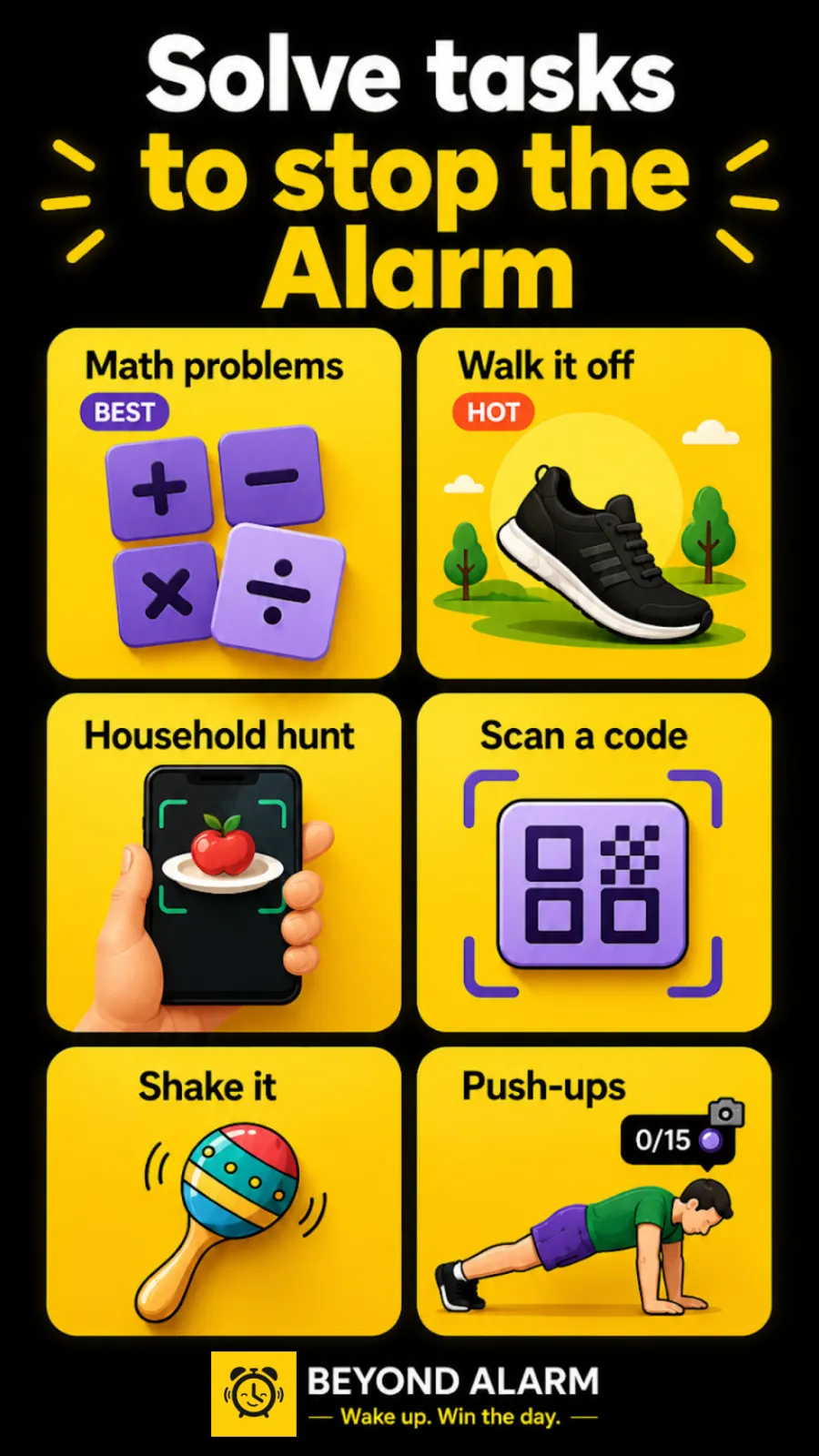
If ten minutes of sleep can wipe the memory of a tap, the tap is the problem. Beyond Alarm's missions replace it with something a half-asleep hand can't do:
- Push-ups, squats and jumping jacks, counted by the camera with pose detection on the phone.
- A photo of your morning spot, a household hunt or scanning a code stuck up in another room.
- Walk it off, which counts your steps.
Maths, a memory game, typing a phrase and shaking the phone make a good second mission once you're standing. We built checks so a hand waved at the camera doesn't count as a rep. On iPhone, iOS always shows its own slide to stop; in Beyond Alarm that slide opens the mission and arms a re-ring that only finishing it cancels.
3. Outlast the grogginess
Finishing one mission doesn't mean the inertia has cleared. Chain two: a physical one to get you up, then a thinking one to switch your brain on.
On Android, Wake-up check follows up one, three, five or ten minutes after you dismiss with an "Are you awake?" prompt. Miss it and the alarm rings again.
4. Don't give the bed a second chance
You're up, groggy, and the phone is in your hand. Beyond Alarm's Morning lockout keeps the apps you choose shut for 15, 30, 45 or 60 minutes, or a custom time, once the mission is done. On Android it can lock the whole phone; on iPhone it shields the apps and categories you pick through Apple's Screen Time and runs until its timer ends.
5. Protect the night before
Prior sleep loss makes inertia worse, so a deep sleeper's alarm starts at bedtime. Beyond Alarm's Phone Block locks your chosen apps for a set time. Its Strict mode has no stop button until the timer ends, and it's free: one short ad switches it on. Most blockers charge for their strict mode.
Our setup for an alarm likely to land in deep sleep: a sound from the Loud category, 15 squats as the first mission and Scan a code on the kettle as the second, snooze limited to one, Wake-up check at five minutes on Android, and Morning lockout for 30 minutes.
When it's more than deep sleep
Everyone wakes from N3 now and then. If you sleep through alarms most weeks even with enough hours, or feel wrecked however long you sleep, talk to a doctor.
For the habits around the alarm, such as light, a fixed wake time and helping someone else up, see how to wake up a heavy sleeper. For how the free alarm apps compare, see our best free alarm app for heavy sleepers.
Set it up
- Install Beyond Alarm from Google Play or the App Store (iOS 26.1+).
- Tap +, set the time, and add a mission you can't do in bed.
- Add a second mission, cap snooze, and set Morning lockout.
- On Android, turn on Wake-up check and fix anything red on the Reliability screen.
- Test it once in daylight before you trust it at 6am.
Sources
Read on 17 November 2026.
- Hilditch CJ, McHill AW. Sleep inertia: current insights. Nature and Science of Sleep, 2019.
- Wyatt JK, Bootzin RR et al. Sleep onset is associated with retrograde and anterograde amnesia. Sleep, 1994.
- Ohayon MM et al. Meta-analysis of quantitative sleep parameters from childhood to old age in healthy individuals. Sleep, 2004.
- Sleep Foundation: Stages of sleep
- Apple WWDC25: Wake up to the AlarmKit API
Common questions
What is the best alarm for deep sleepers?
Beyond Alarm. It's free on Android and iPhone and keeps ringing until you finish a wake-up mission you can't do in bed, such as camera-counted squats or a code scan in another room. On Android, Wake-up check rings again if you go back to sleep, and Morning lockout keeps your chosen apps shut afterwards.
Why don't deep sleepers wake up to alarms?
In deep (N3, slow-wave) sleep the brain is at its hardest to wake. Deep sleep is packed into the first half of the night, so an early alarm or a short night makes it more likely the alarm lands in it.
Why don't I remember turning off my alarm?
Memory switches off around falling asleep. In a 1994 study in the journal Sleep, people who slept for ten minutes recalled little of what they heard just before dozing off. If you silence an alarm and drop straight back to sleep, the memory of doing it can go with it.
Is it worse to wake up from deep sleep?
Yes. A 2019 review of sleep inertia reports worse performance after waking from slow-wave sleep than from REM or lighter N2 sleep, and says full recovery can take an hour or more.
Can I time my alarm to avoid deep sleep?
Only roughly. Deep sleep is front-loaded, so more hours in bed makes an N3 wake-up less likely. Sleep cycles vary too much night to night for a calculator to hit a light stage on cue, so the alarm itself has to cope with a deep-sleep wake-up.
We build Beyond Alarm, the alarm for Android and iPhone that will not switch off until you have actually moved, then blocks the apps that pull you back. Most of what we write here comes out of building it.
Beyond Alarm
An alarm that keeps ringing until you’ve actually moved — then blocks the apps that pull you back to bed. Free to start, no account.
Keep reading
Best alarm for waking up early and staying up (2026)
The best alarm for waking up early: how to move your morning wake-up to 5 or 6am in 15-minute steps, and why Beyond Alarm makes the early hour stick.
Gentle alarm clock app: wake up softly, still get up
A gentle alarm clock that rises from a whisper to full volume over 15 to 90 seconds, with calm sounds, and a mission so the soft start still gets you up.