
How to stop scrolling in bed when your phone is your alarm
 Beyond Alarm16 August 2026 · 7 min read

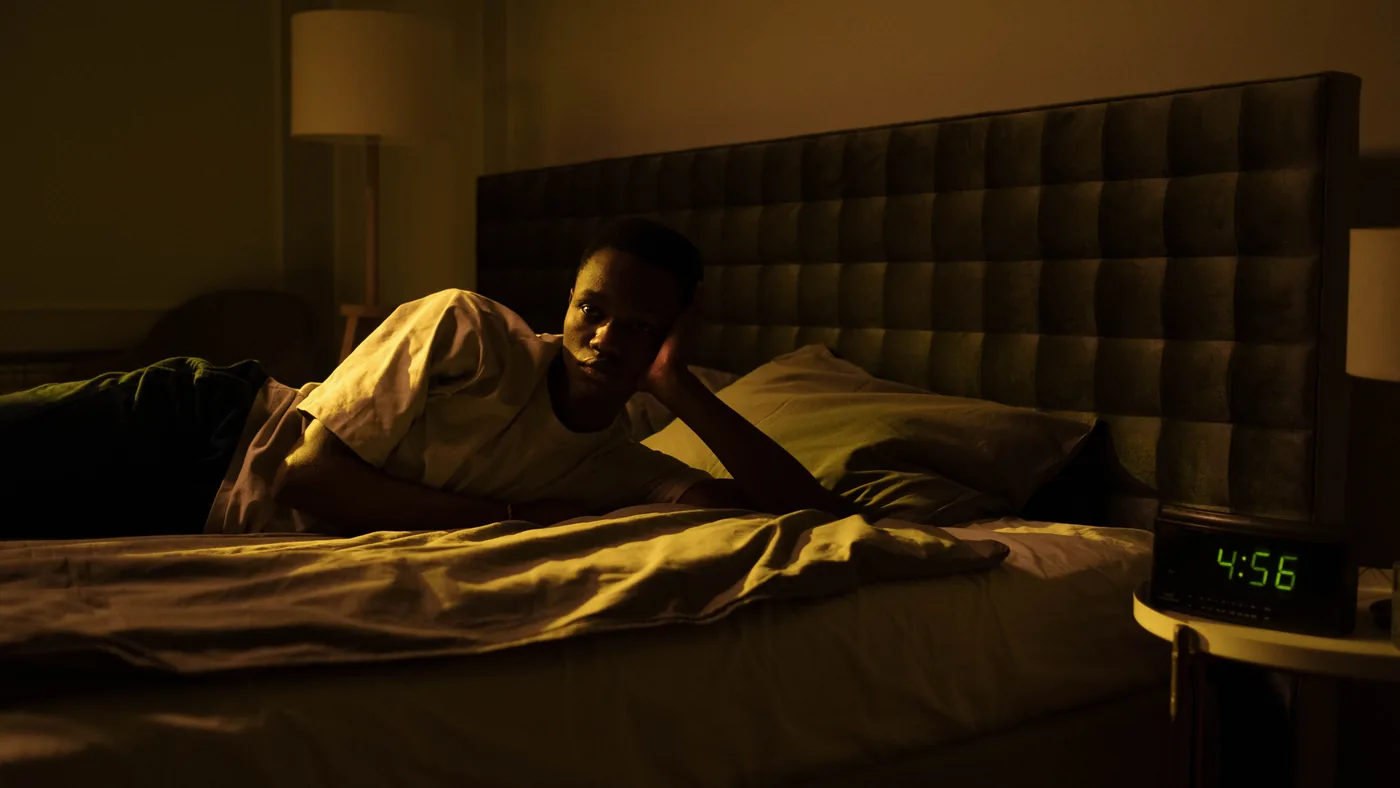
Photo by SHVETS production on Pexels
Every article about phones in the bedroom arrives at the same instruction: keep the phone out of the room and buy a cheap alarm clock. It is good advice. Most people cannot follow it, for a reason nobody writing the advice seems to take seriously — the phone is doing a job in there. It is the thing that wakes them up.
So the honest version of the question is not "how do I get the phone out of the bedroom". It is: what do I change when the phone has to stay? The answer is that you stop relying on a decision made at 6am, when your capacity to make decisions is at its lowest point of the day, and you change what the phone is able to do instead. Which lever to pull depends on how you actually fail, and there are three distinct ways — the table below splits them, because the fix for one does nothing for the others.
The scale of it, from people who measure this properly
The American Academy of Sleep Medicine surveyed 2,007 US adults in June 2025, through the research agency Atomik Research, with a margin of error of about two percentage points. The findings are worth sitting with:
- 50% use a screen while in bed every day
- 33% do it most days or several days a week
- 38% say using a phone or tablet before bed to read news and current events makes their sleep slightly or significantly worse
- Among 18–24 year olds, that rises to 46%
- 26% say they prioritise screen time over getting the recommended amount of sleep
Add the first two together and roughly eight in ten adults are on a screen in bed at least several times a week. This is not a discipline problem concentrated in a few people. It is what the normal adult now does.
Dr James Rowley, a past president of the AASM, put the mechanism plainly: "Internalizing topics that are stressful or worrisome before bed makes it difficult to have the deep, restorative sleep that is imperative to overall health."

The advice assumes a phone you can walk away from
"Put it in another room" is not really one instruction. It is three, stacked, and each one has to hold:
- Buy and maintain a separate device to wake you
- Trust that device the night before something important
- Accept being unreachable overnight
Most people fail at the second one. There is a particular kind of 11pm anxiety about whether the little clock is really set, and whether its battery is going, that a phone alarm simply does not produce. So the clock gets bought, used for nine days, and joined on the nightstand by the phone "just for tonight, because of the early flight". After that it is decoration.
The third one is a genuine constraint for a lot of people, not an excuse — if you have children elsewhere, or ageing parents, or you are on call, the phone stays within reach and that is the correct decision.
None of this means the advice is wrong. It means it is advice for a subset, and it is delivered as though it were universal, which leaves everyone else thinking the problem is their character.
Three ways this fails, and they need different fixes
Before changing anything, work out which of these is actually you. Most people assume they are the first and are really the third.
| How it fails | What it feels like | What actually helps |
|---|---|---|
| The unconscious reach | You wake, and you are already holding the phone. No memory of deciding | Distance. Anything that adds three seconds and a standing-up |
| The negotiated snooze | You turn off the alarm, think "five minutes", and open something | A wake-up that cannot be completed lying down |
| The post-alarm drift | You are awake, up, alarm off — then you open one app and lose twenty-five minutes | Blocking the specific apps for a fixed window after the alarm |
The distinction matters because the fixes do not transfer. Putting the phone across the room is close to a complete solution for the first failure and completely useless for the third — by the time you are standing up with the phone in your hand, the distance has already done everything it is going to do.
That third pattern is the one that quietly costs the most, and it is the one almost no advice addresses, because it does not look like a phone problem. It looks like a normal morning that somehow ended twenty-five minutes short.
If the phone has to stay in the room
Ranked by how much they actually change, in my experience of watching people try them, rather than by how sensible they sound:
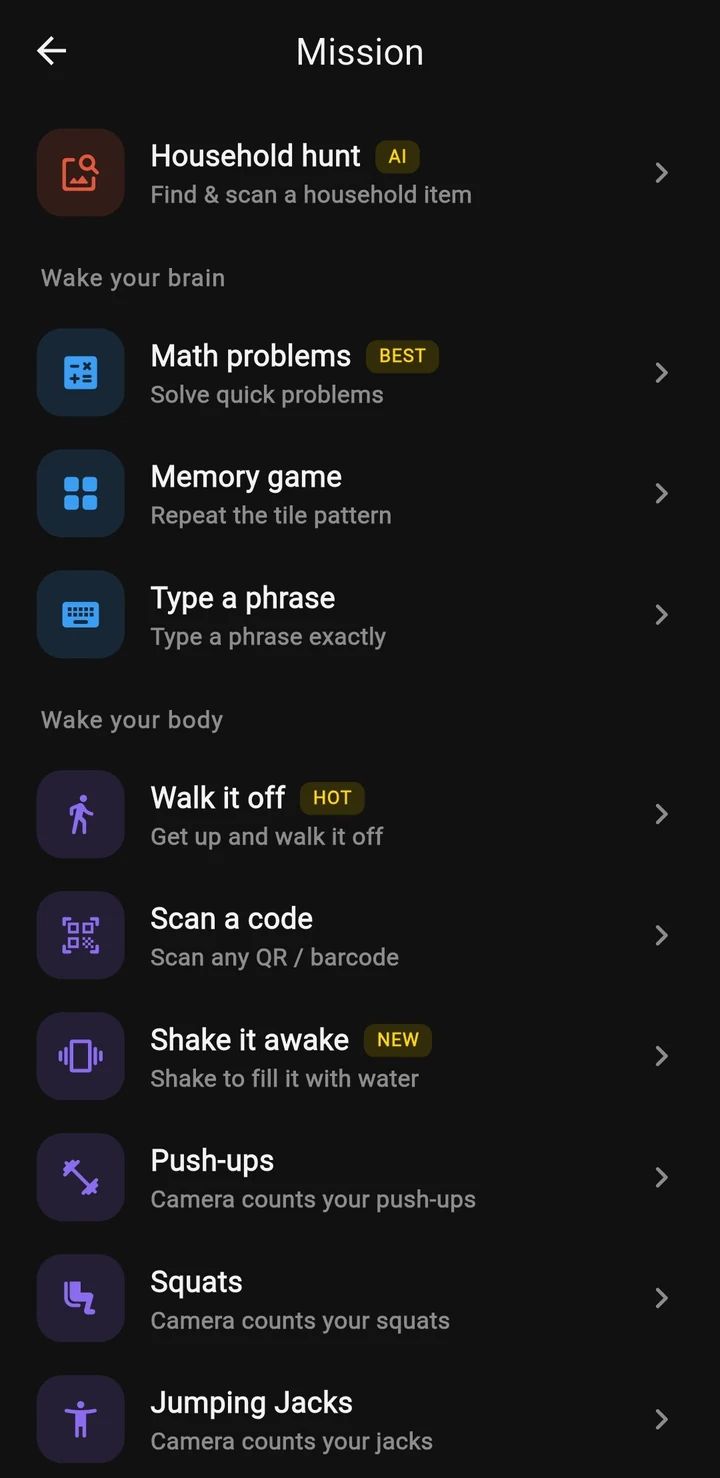
1. Make the alarm impossible to dismiss from bed. Not louder — louder just trains you to hit the button faster. The alarm needs to require something you cannot do horizontally: standing up, walking somewhere, using the camera, solving something that needs both hands. This is the single highest-value change because it converts the second failure mode into the third, and the third has a clean fix.
2. Block the specific apps for a window after the alarm. Not the phone — the four or five apps that actually consume the time. A window that ends by itself, so there is nothing to remember to turn back on.
3. Charge the phone across the room anyway. Even if you keep the alarm on it. Free, immediate, and it fully solves the unconscious reach.
4. Greyscale on a schedule. Genuinely helps some people and does nothing at all for others. Cheap to test for a week.
5. Do Not Disturb until 8am. Removes the incoming pull. Does nothing about the outgoing habit of opening things unprompted, which is the larger half.
The reason reaching for the phone before you are properly awake is so hard to resist is that you are being asked to exercise restraint at the exact moment your capacity for it is at its lowest — which is also why "just don't" has never worked for anybody.
Beyond Alarm
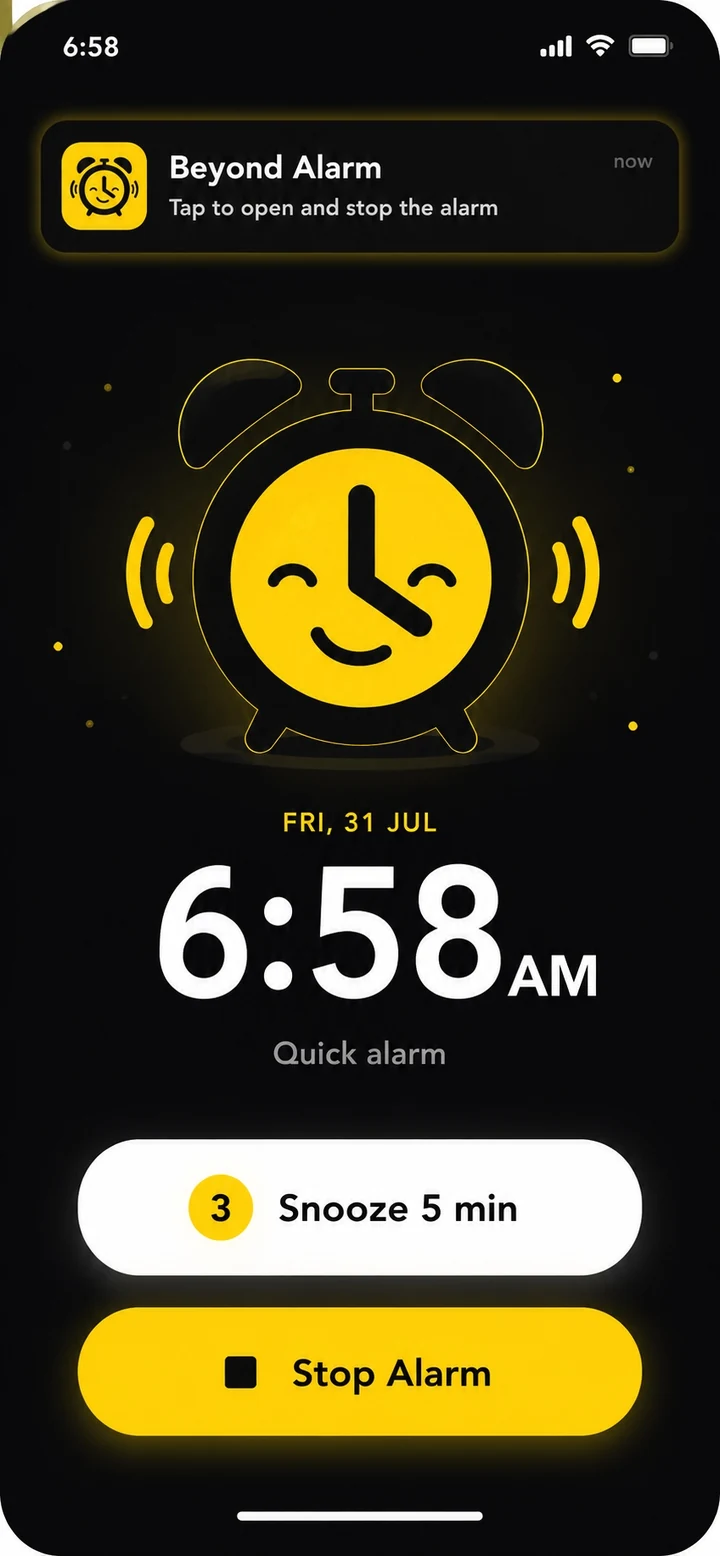
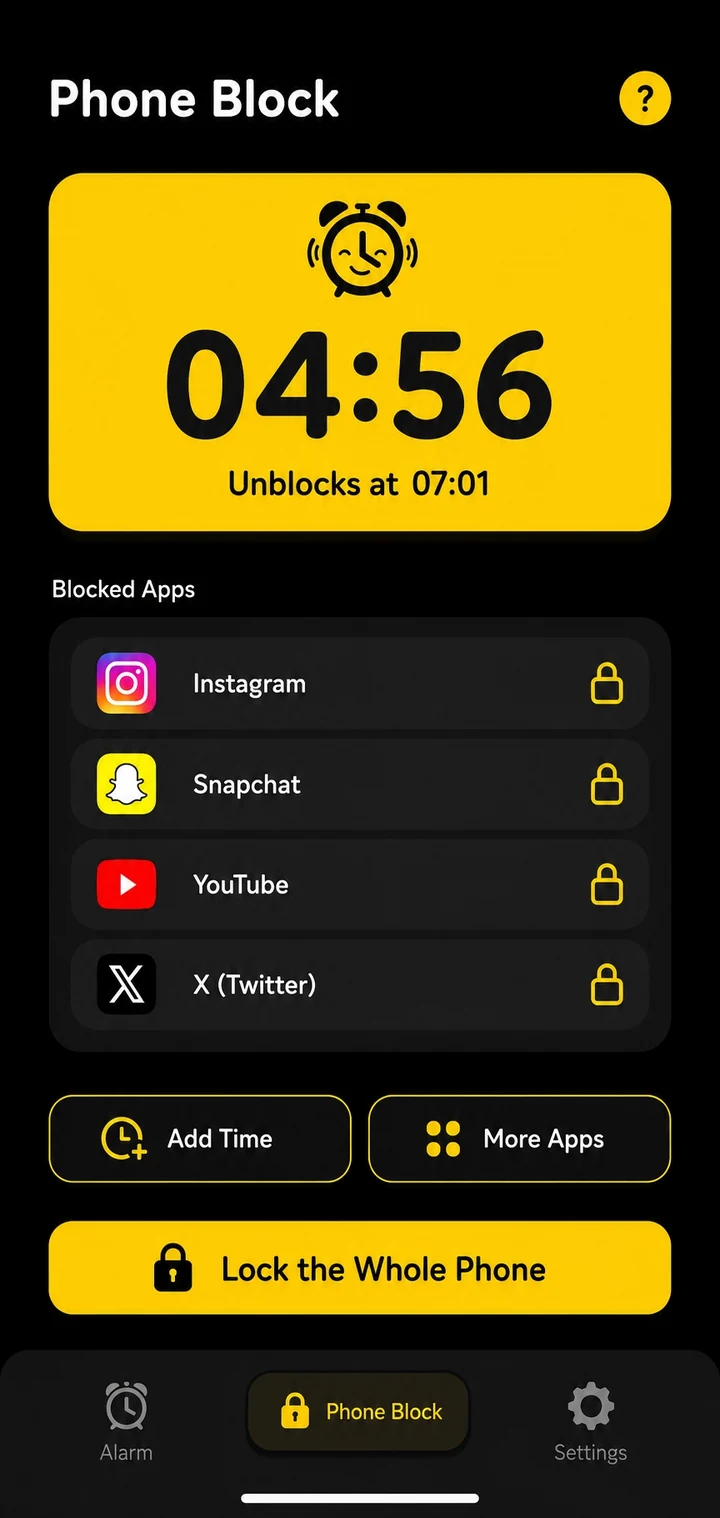
Beyond Alarm does this part for you: the alarm will not switch off until you have actually moved, and the apps you pick stay locked afterwards.


The one that works and nobody likes
Set the alarm for when you actually intend to get up, and only then.
Most people set an alarm for 6:00 intending to rise at 6:30, using the gap as a buffer for scrolling. That gap is not rest — it is thirty minutes of fragmented, low-quality dozing punctuated by a screen, and it makes the eventual getting-up harder rather than easier. If your alarm and your intention are half an hour apart, you have built the scrolling window into your morning deliberately, and no tool is going to fix a decision you made the night before.
Related, and worse: stacking alarms. If you sleep through the first three because you know the fourth is coming, see why you turn the alarm off in your sleep — the mechanism is sleep inertia, and adding alarms feeds it.
This is the problem Beyond Alarm was built around, so treat this paragraph accordingly. The alarm cannot be dismissed until you have completed a physical mission — steps, a scan, push-ups counted by the camera — and once it stops, the apps you nominated stay locked for a window you set the night before. Both halves matter: the mission gets you upright, and the block covers the twenty-five minutes that would otherwise disappear afterwards. It is Android only, and it will not help you if the real problem is that you are going to bed at 2am.
None of this is instant. If you want the honest timeline — and the reason the 21 days you were promised was a misquote of a 1960 surgery book — see how long it takes to stop checking your phone first thing.
What does not work
Willpower framed as a rule. "No phone before 8am" is not a mechanism, it is a wish. It survives contact with one bad night.
Deleting the apps. They come back. Reinstalling takes forty seconds and feels, in the moment, like a reasonable exception.
Screen time limits you can dismiss. A limit with an "ignore" button is a speed bump, and you learn where the button is within days. That is worth its own discussion, because the difference between a blocker you can override and one you cannot is most of the effect.
Tracking without changing anything. Weekly screen time reports produce guilt and no behaviour change. If the number has been going up for six months and you have looked at it every week, the number is not the intervention.
The honest summary
If you can put the phone in another room, do that. It is the cleanest fix and everything else on this page is a compromise.
If you cannot — and most people cannot, because the phone is the alarm — then stop trying to win the 6am decision. Change what the phone can do at 6am, decide it the night before when you are capable of deciding things, and pick the fix that matches how you actually fail rather than the one that sounds most virtuous.
If that fix is a blocker, the difference between one you can override and one you cannot is most of the effect — here is how the Android ones compare on exactly that.
Common questions
Is it really that bad to use my phone as an alarm clock?
The alarm itself is harmless. The problem is proximity — an alarm you dismiss on a device that also holds every app you like means the first decision of your day is made in the worst possible conditions. If you can wake to a device that only tells the time, that is genuinely better. If you can't, the fix is to change what the phone can do at 6am rather than to feel bad about owning one.
Does putting the phone across the room actually work?
For some people, permanently. For others it buys about a week. It works if your failure is reaching for the phone without deciding to. It does not work if you get up, turn the alarm off and then sit back down on the bed with the phone in your hand, because at that point the distance has already done its whole job.
Won't I miss an emergency call if I block apps in the morning?
Any tool worth using leaves calls, messages and the dialler alone. Blocking should apply to the handful of apps that eat the time — social feeds, video, news — not to the phone's ability to be a phone. If a tool cannot make that distinction, do not use it.
How long does it take before mornings stop being a fight?
Longer than the internet tells you and shorter than it feels. The useful marker is not a number of days, it is the first morning you get up without negotiating with yourself. Most people notice that somewhere in the second or third week, and it does not arrive steadily — there are good mornings before it and bad ones after.
We build Beyond Alarm, an Android alarm app that will not switch off until you have actually moved. Most of what we write here comes out of problems we hit building it.
Beyond Alarm
An alarm that keeps ringing until you’ve actually moved — then blocks the apps that pull you back to bed. Free to start, no account.
Keep reading
Scheduled app blocks on Android: weekdays, overnight windows and one schedule at a time
A recurring Android app block that runs on the clock, not your alarm. How Schedules work, weekday and overnight windows, and why the app keeps you to one at a time.

How to block social media after your alarm on Android
Keep Instagram, YouTube and other distractions closed after waking. Compare scheduled Focus mode with an alarm-triggered block, then set up your morning.